
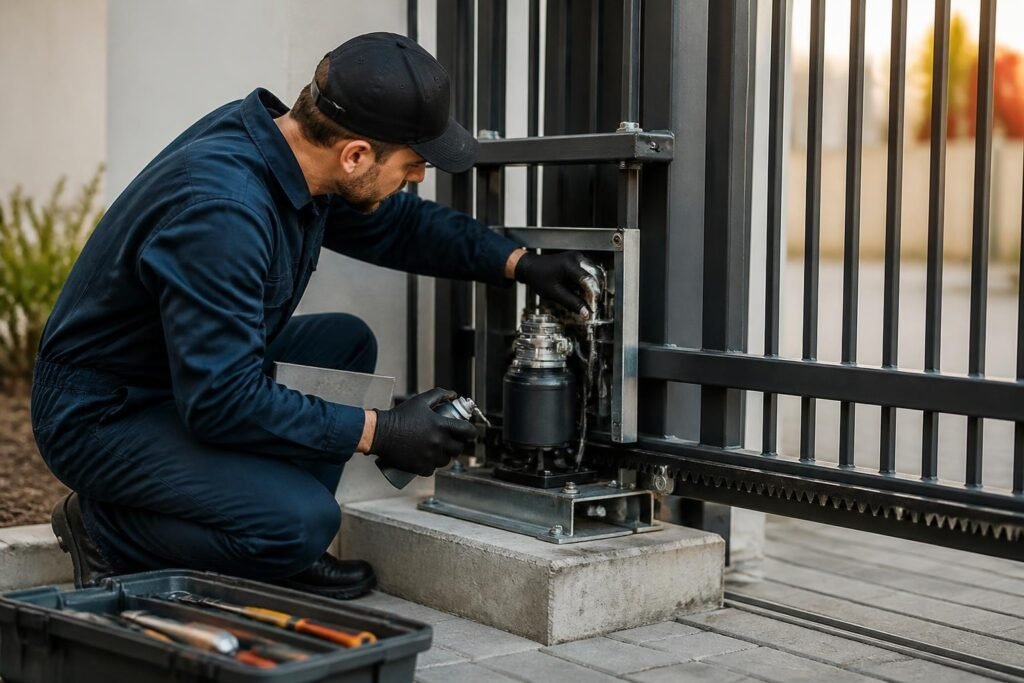
Automatic gates serve as the first line of security for countless residential properties and commercial facilities throughout Los Angeles and beyond. These sophisticated systems combine mechanical components, electrical controls, and safety features that demand regular professional attention to maintain peak performance. Without proper automatic gate servicing, even the most robust systems deteriorate, leading to safety hazards, security vulnerabilities, and expensive emergency repairs. Understanding the comprehensive maintenance requirements for automated gate systems empowers property owners to protect their investment while ensuring uninterrupted operation year after year.
Understanding Automatic Gate System Components
Modern automatic gates represent complex assemblies of interdependent parts that must work in perfect harmony. The operator motor forms the heart of the system, converting electrical energy into mechanical force that moves gates weighing hundreds or thousands of pounds. Drive mechanisms vary by gate type, with chain drives, screw drives, and hydraulic systems each requiring distinct servicing approaches.
Control boards orchestrate every function, processing signals from remotes, keypads, and safety devices while managing motor speed and force limits. These circuit boards contain sensitive electronics vulnerable to moisture, heat, and power surges. Safety sensors create invisible photoelectric beams across gate paths, immediately reversing movement when obstructions appear. Professional electric gate repair addresses all these components as an integrated system rather than isolated parts.
Mechanical Hardware and Structural Elements
The physical gate structure endures constant stress from opening and closing cycles, wind loads, and environmental exposure. Hinges, rollers, and bearings support the gate's weight while enabling smooth movement along tracks or pivot points. Welded joints and mounting brackets transfer operational forces to posts and foundations.
Critical mechanical components requiring regular inspection:
- Track alignment and levelness
- Wheel and roller bearing condition
- Hinge pin wear and lubrication needs
- Chain or belt tension and integrity
- Hydraulic cylinder seal condition
- Mounting bolt tightness
Gate posts and foundations provide essential stability, yet settling soil and freeze-thaw cycles gradually compromise these anchors. Even minor misalignment multiplies stress on operators and hardware, accelerating wear throughout the system.
Establishing a Preventive Maintenance Schedule
Proactive automatic gate servicing prevents the majority of failures that lead to costly repairs and dangerous malfunctions. The frequency of professional maintenance depends on gate usage intensity, environmental conditions, and system complexity. High-traffic commercial installations demand monthly inspections, while residential gates typically require quarterly or semi-annual servicing.
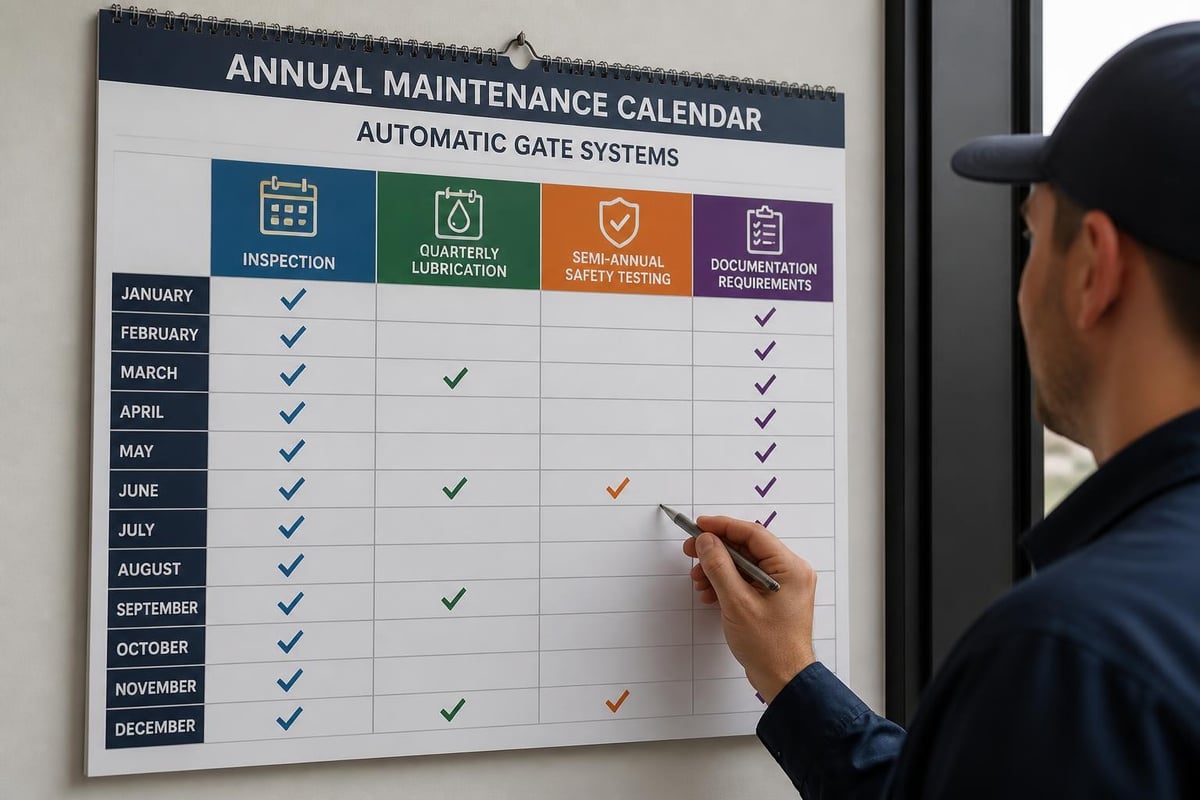
| Service Interval | Residential Gates | Commercial Gates | Critical Tasks |
|---|---|---|---|
| Monthly | Visual inspection | Full inspection | Safety sensor check, unusual noise detection |
| Quarterly | Professional service | Operational testing | Lubrication, adjustment, wear assessment |
| Semi-annually | Deep inspection | Component replacement | Electrical connections, structural integrity |
| Annually | Complete overhaul | System certification | Safety compliance, ASTM F2200 verification |
Environmental factors accelerate degradation in predictable patterns. Coastal properties face salt-air corrosion that attacks metal components and electrical connections. Desert locations contend with abrasive dust infiltrating bearings and control boxes. Properties near industrial zones experience chemical exposure that degrades seals and lubricants.
Usage Pattern Impact on Service Needs
Gate cycle counts directly correlate with component lifespan and maintenance requirements. A residential gate opening 10-15 times daily experiences fundamentally different wear than a parking structure gate cycling 500 times per day. Commercial operators should track cycle counts through control board diagnostics to predict component replacement intervals accurately.
Heavy-duty applications require upgrading to industrial-grade components designed for continuous operation. Standard residential operators installed in commercial settings fail prematurely, creating liability risks and operational disruptions. Understanding commercial gate repair requirements helps businesses specify appropriate equipment from initial installation.
Comprehensive Safety System Testing
Safety features represent the most critical aspect of automatic gate servicing, directly protecting lives and preventing serious injuries. Modern gate operators incorporate multiple redundant safety mechanisms that must function perfectly every time. Testing protocols verify each safety device independently and as part of the integrated system.
Photoelectric sensors require precise alignment to create reliable detection beams across gate paths. Dust accumulation on sensor lenses, physical impacts, and thermal expansion gradually degrade performance. Professional technicians test sensors by introducing obstructions at various heights and positions, confirming immediate reversal responses.
Essential safety tests performed during servicing:
- Photoelectric sensor alignment and response time
- Edge sensor compression and rebound function
- Entrapment protection force limits
- Emergency release mechanism operation
- Battery backup system capacity
- Manual override accessibility
The UL 325 safety standard establishes entrapment protection requirements that automatic gates must satisfy. Operators must reverse or stop within specified distances when encountering resistance, preventing crushing injuries. Force adjustment requires specialized equipment measuring actual contact pressure against thresholds defined by gate type and installation.
Emergency Access and Override Systems
Battery backup systems maintain gate operation during power failures, ensuring emergency vehicles can access gated communities and facilities. These batteries degrade over time, losing capacity to power multiple open-close cycles. Annual load testing verifies backup performance under realistic conditions, identifying failing batteries before emergencies arise.
Manual release mechanisms allow physical gate operation when automated systems fail completely. These emergency overrides must remain accessible yet secure from unauthorized use. Corrosion, paint buildup, and mechanical binding prevent release operation in many installations. Regular exercise and lubrication keep emergency systems ready for critical moments.
Electrical System Inspection and Maintenance
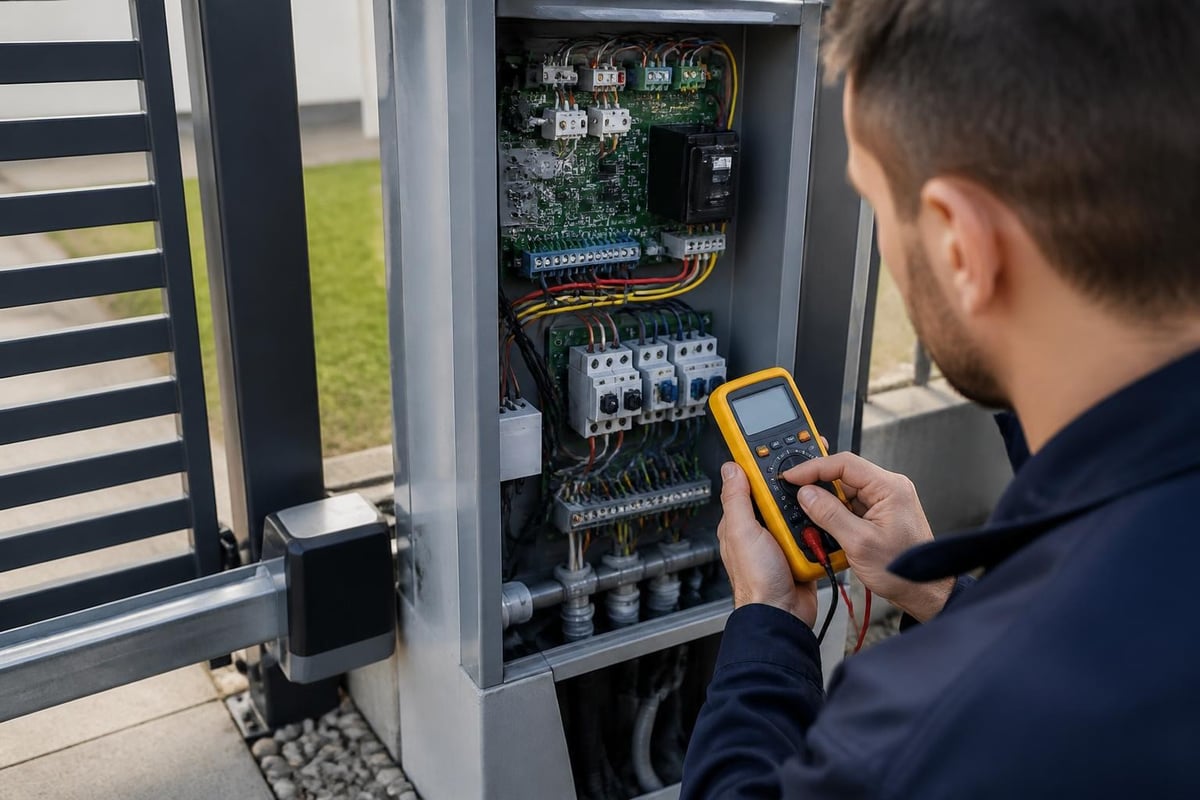
Electrical components demand specialized attention during automatic gate servicing, as failures create both operational problems and serious safety hazards. Control boards contain programmable logic controllers processing multiple inputs simultaneously while managing complex timing sequences. Circuit board inspection identifies corrosion on terminals, failed capacitors, and damaged traces before they cause complete system failures.
Wiring connections throughout automatic gate installations face harsh environmental exposure. Underground conduits collect water through capillary action and condensation, submerging wire splices in corrosive moisture. Aerial cables experience ultraviolet degradation and wind abrasion. Junction boxes and operator enclosures must meet appropriate NEMA ratings for outdoor exposure and potential water intrusion.
Power Supply and Voltage Stability
Consistent voltage supply ensures reliable operator performance and extends control board lifespan. Brownout conditions and voltage spikes stress electronic components, causing erratic behavior and premature failures. Testing supply voltage under load conditions reveals inadequate wiring, poor connections, and utility power quality issues.
Dedicated circuit protection prevents nuisance tripping while providing essential fault protection. Ground fault circuit interrupter (GFCI) requirements vary by jurisdiction and installation specifics, yet proper grounding remains universally critical. Following National Electrical Code provisions ensures installations meet current safety standards and maintain compliance as regulations evolve.
Mechanical Adjustment and Lubrication
Proper lubrication reduces friction, prevents corrosion, and extends component life throughout automatic gate assemblies. Different components require specific lubricant types optimized for their operating conditions and materials. Chain drives need heavier petroleum-based lubricants that resist flinging under centrifugal forces. Hinge pins and bearings perform best with lighter synthetic oils penetrating tight tolerances.
Over-lubrication creates problems as severe as insufficient lubrication. Excess grease attracts dust and debris, forming abrasive compounds that accelerate wear. Dripping lubricants create slip hazards and environmental concerns. Professional automatic gate servicing applies precise quantities of appropriate products to each component.
| Component | Lubricant Type | Application Method | Frequency |
|---|---|---|---|
| Hinges/Pivot Points | Synthetic oil | Spray or brush | Quarterly |
| Roller Bearings | High-temp grease | Grease gun | Semi-annually |
| Drive Chains | Heavy-duty chain lube | Spray while operating | Monthly |
| Track Channels | Dry silicone | Wipe-on application | Semi-annually |
Gate alignment directly affects operator stress levels and component wear rates. Sagging gates force operators to work against gravity, overheating motors and straining drive mechanisms. Track misalignment causes binding that triggers safety reversals and prevents complete closing. Measuring gate squareness, checking diagonal dimensions, and verifying track levelness identifies adjustment needs before catastrophic failures occur.
Operator Adjustment and Force Tuning
Modern gate operators incorporate adjustable parameters controlling opening speed, closing speed, and force limits for both directions. These settings balance operational efficiency against safety requirements and component longevity. Fast operation improves traffic flow but increases impact forces and wear. Excessively slow operation frustrates users and exposes gates to vandalism during extended cycles.
Force limit adjustments require particular care to maintain compliance with entrapment protection standards while providing sufficient power for reliable operation. Wind resistance, gate weight, and friction vary seasonally, demanding periodic readjustment. Professional technicians use diagnostic tools reading actual force requirements, setting limits with appropriate safety margins.
Access Control Integration and Testing
Automatic gates typically integrate with various access control devices that authenticate users and trigger gate operations. Remote transmitters, keypad entry systems, card readers, and smartphone applications each present distinct servicing requirements. Radio frequency interference from nearby transmitters can disrupt remote operation, requiring channel reprogramming or upgraded receivers.
Keypad systems endure direct weather exposure and physical abuse from repeated button presses. Membrane switches degrade over time, creating intermittent operation or complete failure. Cleaning contacts, testing all code combinations, and verifying proper lockout functions prevents security vulnerabilities and access disruptions.
Access control components requiring regular attention:
- Remote receiver sensitivity and range
- Keypad button response and weatherproofing
- Card reader optics and data transmission
- Loop detector sensitivity and wire integrity
- Intercom audio quality and video clarity
Loop detector systems buried in pavement sense vehicles through electromagnetic field disturbances, automatically triggering gate opening for exiting traffic. These underground loops experience wire breaks from ground movement, pavement cracking, and excavation damage. Testing loop inductance and response consistency identifies developing problems before detection failures strand vehicles.
Compliance and Accessibility Requirements
Automatic gate installations must comply with federal accessibility standards when serving public accommodations or commercial facilities. The Americans with Disabilities Act requirements specify maximum opening forces, clear widths, and accessible control placement for powered gates. Regular compliance verification during automatic gate servicing prevents violations and ensures equal access for all users.
Accessibility audit procedure for automatic gates covering control height requirements, operating force measurements, clear opening width verification, and alternative access methods for individuals with disabilities
Industrial facilities face additional requirements under OSHA machine guarding standards protecting workers from hazardous moving parts. Proper guarding prevents access to pinch points, shear edges, and rotating components while allowing necessary maintenance activities. Annual safety audits document compliance and identify corrective actions.
State and local building codes often impose specific requirements for automatic gate installations beyond federal minimums. California regulations address seismic considerations, while coastal jurisdictions mandate corrosion-resistant materials. Maintaining current knowledge of applicable codes ensures installations remain compliant as standards evolve and jurisdictions update regulations.
Diagnostic Tools and Professional Equipment
Effective automatic gate servicing requires specialized diagnostic equipment beyond basic hand tools. Multimeters measure voltage, current, and resistance throughout electrical systems, identifying power supply problems and component failures. Infrared thermometers detect overheating motors, binding components, and electrical resistance issues before visible symptoms appear.
Force gauges quantify actual gate operating forces against safety standard limits, providing objective measurements for adjustment decisions. Oscilloscopes reveal electrical noise, signal timing issues, and component malfunction patterns invisible to simple voltage testing. Professional service providers invest in diagnostic equipment that speeds troubleshooting and improves repair accuracy.
The complexity of modern automatic gate systems increasingly demands manufacturer-specific programming tools for control board adjustment and diagnostics. Proprietary software accesses detailed operational parameters, logs fault codes, and enables advanced feature configuration. This specialization emphasizes the value of choosing service providers with comprehensive equipment and training.
Environmental Protection and Weatherproofing
Outdoor installation exposes automatic gate components to extreme temperature swings, precipitation, ultraviolet radiation, and corrosive atmospheric conditions. Control boxes require weather-resistant enclosures with proper gasket seals preventing water intrusion. Vented enclosures balance moisture protection against heat dissipation needs for electronics generating significant thermal loads.
Corrosion protection extends equipment lifespan in challenging environments. Stainless steel hardware resists oxidation better than zinc-plated alternatives. Powder coating provides durable finish protection superior to paint. Regular inspection identifies rust development early, allowing protective coating renewal before structural degradation occurs.
Extreme temperatures affect lubrication viscosity, battery performance, and material dimensions. Summer heat thins lubricants and expands metal components, while winter cold stiffens seals and contracts materials. Seasonal automatic gate servicing adjusts for these environmental variations, maintaining optimal performance year-round.
Documentation and Service Records
Comprehensive service documentation creates invaluable historical records tracking system performance, component replacements, and adjustment evolution over time. Detailed service reports identify recurring problems suggesting design deficiencies or environmental challenges requiring upgraded solutions. Warranty claims and insurance investigations rely on thorough maintenance records demonstrating proper care and professional servicing.
Digital photographs document pre-service conditions, worn components, and completed repairs. Time-stamped images provide objective evidence for liability protection and help property managers justify maintenance expenditures. Video recordings demonstrate intermittent faults and operational anomalies difficult to capture through written descriptions alone.
Maintenance logs should record specific measurements including gate travel times, force readings, and safety sensor activation distances. Trending these quantitative values reveals gradual degradation patterns predicting impending failures. Proactive component replacement based on measured deterioration prevents emergency breakdowns and extends overall system life.
Regular automatic gate servicing protects your security investment while ensuring safe, reliable operation for years to come. Professional maintenance identifies developing problems before they escalate into expensive failures or dangerous malfunctions. Whether you need routine preventive care or emergency repairs for residential or commercial automatic gate systems, Gates On Site delivers expert service throughout Los Angeles with same-day response and over 20 years of specialized experience.