
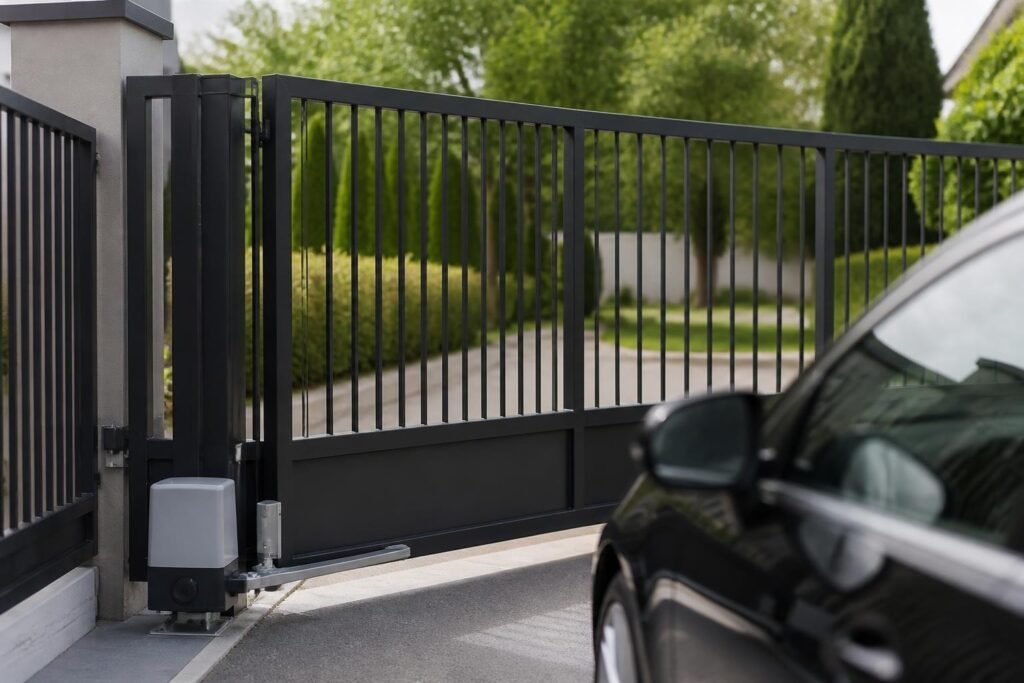
A motorized gate for driveway installations represents a significant investment in property security, convenience, and curb appeal. Modern automated gate systems combine sophisticated access control technology with robust construction to manage vehicle entry while meeting stringent safety standards. Whether protecting a residential estate or securing a commercial facility, understanding the technical specifications, safety requirements, and operational characteristics of motorized driveway gates ensures you select and maintain a system that performs reliably for decades.
Understanding Motorized Driveway Gate Systems
Motorized gate systems consist of several integrated components working together to provide automated access control. The operator (or actuator) supplies the mechanical force to move the gate, while control boards manage inputs from keypads, remote transmitters, loop detectors, and safety devices.
Gate operators fall into two primary categories based on application: residential-duty and commercial-duty. Residential operators typically handle 15-25 cycles per day, while commercial-duty systems accommodate 100 or more daily cycles. Understanding cycle ratings prevents premature failure and ensures your motorized gate for driveway applications matches actual usage patterns.
Core Components and Their Functions
Every automated gate system includes specific elements that work in coordination:
- Gate operator: Electromechanical device providing opening/closing force
- Control board: Manages inputs, safety circuits, and operator commands
- Access control devices: Keypads, card readers, remote transmitters, smartphone apps
- Safety sensors: Photoelectric eyes, edge sensors, loop detectors
- Power supply: Transformer, battery backup for grid-independent operation
- Gate structure: The physical barrier (swing or slide configuration)
The UL 325 safety standard establishes requirements for automatic gate operators, mandating entrapment protection devices that detect obstructions and reverse gate movement. Compliance with this standard isn't optional-it's essential for liability protection and insurance coverage.
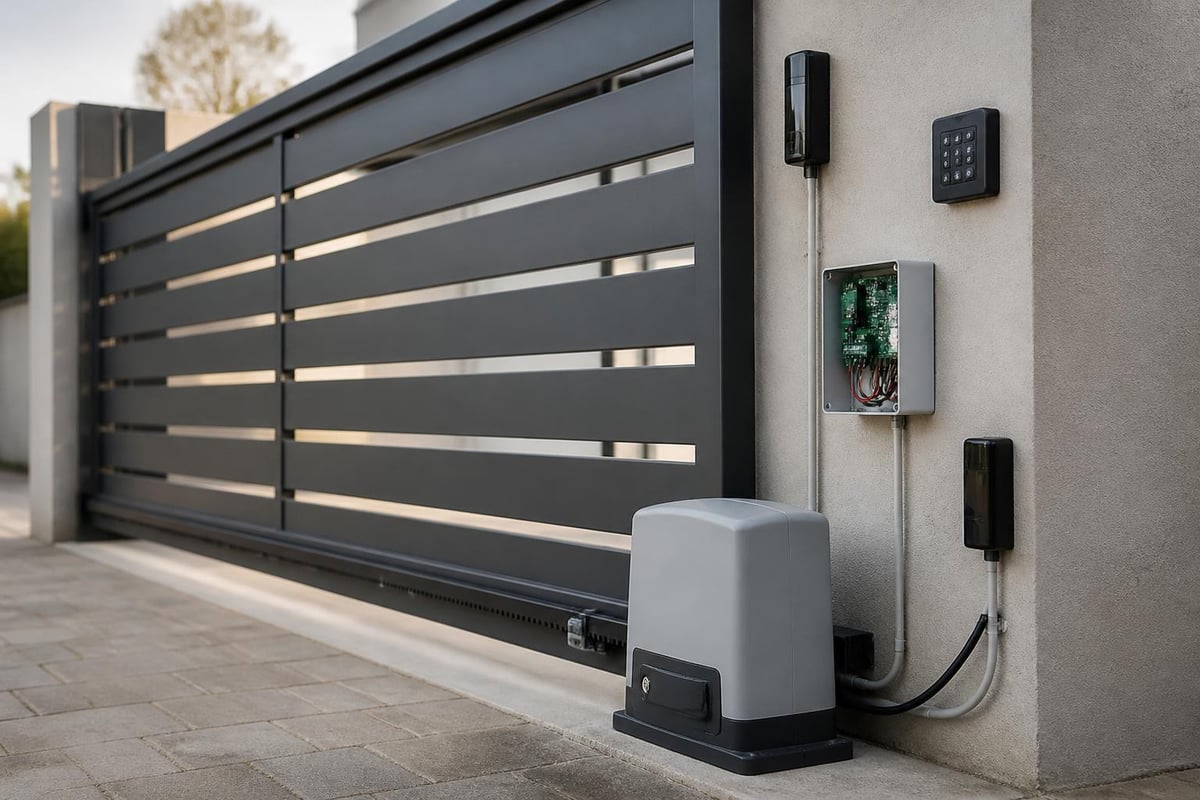
Swing Gate vs. Slide Gate Configurations
Selecting between swing and slide configurations depends on driveway geometry, slope, clearance requirements, and aesthetic preferences. Each design offers distinct advantages and installation considerations.
Swing gates operate like traditional doors, pivoting on hinges mounted to posts or walls. They require clearance equal to the gate width within the property. Dual-swing configurations split the opening between two panels, reducing individual panel size and operator load.
Slide gates traverse laterally along a track, requiring no inward clearance. They're ideal for sloped driveways or properties with limited setback. A cantilever slide gate eliminates the ground track, preventing snow, debris, or ice accumulation from interfering with operation.
| Feature | Swing Gate | Slide Gate |
|---|---|---|
| Clearance Required | Inward arc equal to gate width | Lateral space along fence line |
| Slope Tolerance | Limited (typically under 5°) | Excellent (up to 15° with proper design) |
| Opening Speed | Moderate (5-15 seconds) | Fast (8-20 seconds depending on length) |
| Power Consumption | Lower | Higher (heavier loads) |
| Maintenance | Hinge lubrication, operator alignment | Track cleaning, roller inspection |
| Wind Resistance | Higher surface area catches wind | Lower profile, less wind load |
The ASTM F2200 standard provides comprehensive specifications for automated vehicular gate construction, covering materials, structural calculations, and performance testing protocols that ensure gates withstand environmental loads and repeated cycling.
Operator Types and Selection Criteria
Choosing the appropriate operator type directly impacts reliability, longevity, and maintenance requirements. Operators are classified by mounting configuration and actuation method.
Swing Gate Operators
Articulated arm operators mount to posts and connect to gates via mechanical arms. They accommodate various gate weights (up to 2,000 pounds per leaf) and provide adjustable opening angles. These versatile units install easily and allow post-to-hinge distances up to 8 feet.
Linear actuators (ram-style) offer a compact, low-profile alternative for tight installations. They deliver powerful thrust through a telescoping arm but require closer post-to-hinge spacing (typically 6-18 inches).
Underground operators install beneath the gate pivot point, completely concealing the mechanism. They preserve architectural aesthetics but demand concrete vaults and professional installation with proper drainage.
Slide Gate Operators
Rack-and-pinion operators engage a toothed rack mounted to the gate bottom rail. A motorized pinion gear drives the rack, providing reliable operation for gates up to 2,500 pounds and 100 feet in length.
Chain-drive operators use industrial roller chain to pull gates along the track. They accommodate extremely heavy or long gates and offer easy installation, though they require periodic chain tension adjustment.
Screw-drive operators employ a rotating threaded rod engaging a carriage mounted to the gate. They deliver smooth, quiet operation ideal for residential applications but have more limited capacity than rack-and-pinion systems.
Safety Systems and Compliance Requirements
Safety features protect users, visitors, and vehicles from entrapment or impact injuries. Regulatory compliance isn't merely advisable-it's legally mandated in most jurisdictions and required for insurance coverage.
Every motorized gate for driveway installations must include entrapment protection conforming to UL 325. This standard classifies operators by application and mandates specific safety devices for each class. Third-party testing and certification verify compliance before products enter the market.
Mandatory Safety Devices
Professional installations incorporate multiple layers of protection:
- Photoelectric sensors: Infrared beams across the gate path detect vehicles or pedestrians
- Edge sensors: Pressure-sensitive strips mounted to gate leading edges
- Vehicle loop detectors: Inductance loops embedded in pavement sense metal objects
- Timer-to-close limits: Prevents gates from remaining open indefinitely
- Adjustable force limits: Stops movement when encountering resistance
- Manual release mechanisms: Allows gate operation during power failures
The International Property Maintenance Code establishes maintenance obligations for automated gate systems, requiring property owners to maintain safety features in operational condition and conduct periodic inspections.
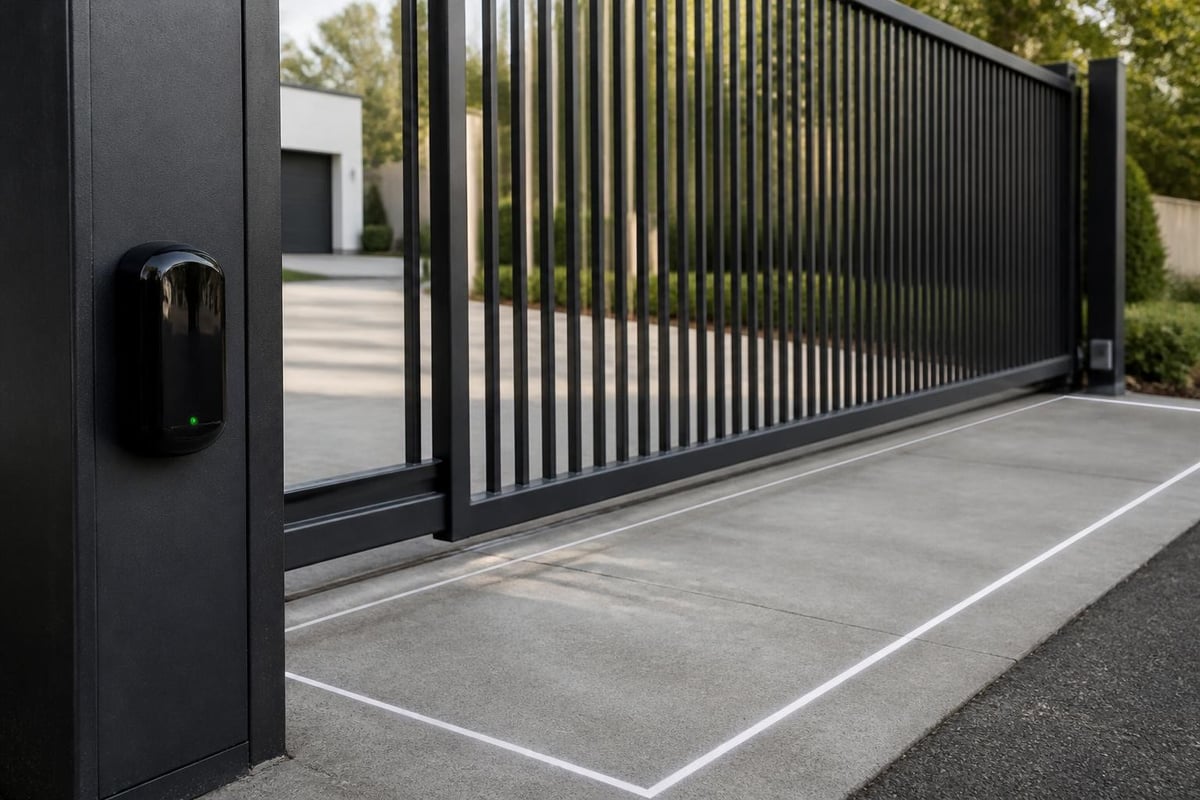
When fire department access is required, gates must include emergency override systems allowing first responders to enter the property. NFPA standards address automatic vehicular gates in fire and life-safety contexts, specifying approved override methods including Knox boxes, strobe light sensors, and siren detection systems that automatically open gates for emergency vehicles.
Access Control Integration Options
Modern motorized gate systems integrate seamlessly with sophisticated access control technologies, enabling property owners to manage entry permissions remotely and maintain detailed access logs.
Traditional access methods include:
- Wireless remote transmitters: Coded rolling-code systems preventing signal interception
- Keypads: PIN-based entry with programmable user codes
- Telephone entry systems: Visitors call residents who grant access remotely
- Card readers: RFID or magnetic stripe credentials for authorized users
Advanced systems leverage network connectivity for enhanced capabilities. Cloud-based platforms allow smartphone control, temporary visitor codes, delivery driver scheduling, and real-time activity notifications. Integration with smart home ecosystems enables automation routines-gates that open automatically when your vehicle approaches or close at sunset.
Biometric access control (fingerprint or facial recognition) provides the highest security level, eliminating credential sharing or theft. However, these systems require careful consideration of ADA accessibility requirements to ensure all authorized users can operate the gate regardless of physical capabilities.
Installation Considerations and Site Preparation
Proper installation determines whether your motorized gate for driveway applications operates reliably for years or requires frequent service calls. Professional assessment of site conditions prevents costly mistakes.
Critical Site Factors
Driveway slope: Grades exceeding 5% affect swing gate operation and may require counterbalance systems. Slide gates handle slopes more effectively but need operator sizing calculations accounting for gravity loads.
Soil conditions: Soft or unstable soil requires deeper post foundations with increased concrete volume. Clay soils demand drainage considerations preventing frost heave in cold climates.
Utility clearances: Underground utilities (water, gas, electrical, telecommunications) must be located before excavation. Overhead clearances affect gate height and swing radius.
Wind exposure: Coastal or elevated locations experience higher wind loads requiring structural reinforcement and operator capacity increases.
Foundation specifications vary by gate type and size, but typical installations require:
| Component | Swing Gate Foundation | Slide Gate Foundation |
|---|---|---|
| Post Depth | 36-48 inches | Track support: 12-18 inches |
| Post Concrete Volume | 2-4 cubic feet per post | Continuous pier under track |
| Curing Time | Minimum 7 days | 3-5 days for light-duty |
| Reinforcement | Rebar cage recommended | Wire mesh or rebar |
Professional installers also address drainage around gate foundations, preventing water accumulation that causes freeze-thaw damage or undermines structural stability.
Power Supply and Battery Backup Systems
Reliable power delivery ensures uninterrupted gate operation. Most motorized gate operators function on low-voltage DC power (12V or 24V) supplied by transformers converting standard 120V AC line voltage.
Battery backup systems maintain gate operation during power outages-a critical consideration for properties where vehicle access cannot be interrupted. Sealed lead-acid or lithium-ion batteries charge continuously during normal operation and automatically supply power when grid voltage drops.
Battery capacity determines how many gate cycles the system can complete without line power. Calculate requirements based on anticipated outage duration and daily usage:
- Small residential system: 12V / 7Ah battery (approximately 20-30 cycles)
- Large residential system: 24V / 12Ah battery (approximately 40-60 cycles)
- Commercial system: 24V / 24Ah battery (approximately 100-150 cycles)
Solar power integration offers grid-independent operation ideal for remote locations or properties emphasizing sustainability. Modern solar gate operators include charge controllers, battery banks, and photovoltaic panels sized to maintain operation through several overcast days.
When professional electric gate repair becomes necessary due to power system failures, experienced technicians diagnose charging circuits, test battery condition, and replace degraded components to restore reliable operation.
Maintenance Requirements and Service Intervals
Preventive maintenance extends equipment life, reduces repair costs, and maintains safety system effectiveness. A motorized gate for driveway applications requires regular attention to mechanical, electrical, and structural components.
Monthly Owner Inspections
Property owners should conduct basic monthly checks:
- Test photoelectric sensors by interrupting beams during gate movement
- Verify edge sensor response by pressing safety edges
- Inspect gate panels for loose hinges, damaged rollers, or track alignment
- Confirm remote transmitter operation and battery condition
- Listen for unusual noises indicating bearing wear or mechanical binding
Quarterly Professional Service
Qualified technicians should perform comprehensive inspections quarterly for commercial installations and annually for residential systems. Service includes:
- Lubricate all pivot points, hinges, and rollers with appropriate grease
- Inspect and adjust chain or belt tension on slide gate operators
- Test safety system response times and adjust sensitivity
- Clean track channels and remove debris from wheel paths
- Verify force limit settings prevent excessive closing pressure
- Inspect wiring for damage, corrosion, or loose connections
- Test battery backup capacity under load
Gate Safe provides authoritative guidance for automated gate maintenance, including risk assessment frameworks and inspection checklists applicable worldwide. Their resources help property owners understand maintenance obligations and identify qualified service providers.
Security Enhancement and Crime Prevention
Beyond access control, motorized gates contribute to comprehensive security strategies through physical barriers, surveillance integration, and psychological deterrence. Properties with automated gates experience measurably lower unauthorized entry rates.
Effective security design follows Crime Prevention Through Environmental Design (CPTED) principles, combining physical security with visibility and access control. The Department of Justice research on camera use at access points demonstrates that visible surveillance combined with controlled entry significantly reduces criminal activity.
Integrate these security enhancements with your motorized driveway gate:
- Video surveillance: Cameras positioned to capture license plates and occupant faces
- Intercom systems: Two-way communication with visitors before granting access
- Motion-activated lighting: Illuminates gate area when vehicles approach
- Anti-tailgating sensors: Detects multiple vehicles attempting to enter on single authorization
- Alarm system integration: Links gate activity to central security monitoring
For commercial properties, access logs provide audit trails showing who entered, when, and through which credentials. This data proves invaluable for investigating security incidents and managing contractor access to facilities.
Cost Factors and Return on Investment
Investment in a motorized gate for driveway applications varies significantly based on configuration, features, and site conditions. Understanding cost components helps property owners budget appropriately and evaluate contractors.
Typical residential motorized gate installations range from $3,500 to $12,000, while commercial systems extend from $8,000 to $50,000 or more. Cost factors include:
Equipment costs:
- Basic single swing operator: $600-$1,200
- Commercial-duty slide operator: $1,500-$4,000
- Custom ornamental gate panels: $2,000-$15,000
- Access control systems: $300-$3,000
Installation labor:
- Site preparation and foundations: $800-$2,500
- Electrical service and conduit: $400-$1,500
- Operator mounting and programming: $600-$1,800
- Safety system installation: $300-$800
Ongoing costs:
- Annual maintenance: $200-$600
- Electricity (typical residential): $15-$40 annually
- Battery replacement (every 3-5 years): $50-$200
Return on investment extends beyond monetary considerations. Insurance carriers frequently offer premium reductions for properties with controlled access gates. Real estate professionals report that automated gates increase property values by 3-7% in appropriate markets, and homes with gates typically sell faster than comparable properties without access control.
Material Selection and Durability
Gate panel materials dramatically affect appearance, maintenance requirements, and service life. Selection should balance aesthetic preferences with environmental conditions and budget constraints.
Wrought iron offers classic appearance and exceptional strength but requires regular painting in humid or coastal environments. Modern powder-coat finishes extend repainting intervals to 8-12 years with proper preparation.
Aluminum provides excellent corrosion resistance while reducing operator load due to lighter weight. Marine-grade aluminum alloys withstand salt-air exposure without degradation. Aluminum gates cost 15-30% more than equivalent steel designs but eliminate rust concerns.
Steel delivers maximum security and impact resistance at moderate cost. Galvanized steel with quality paint systems performs well in most climates. Expect 5-8 year repainting intervals for cosmetic maintenance.
Wood creates traditional, residential aesthetics but demands the most maintenance. Cedar and redwood offer natural rot resistance, while pressure-treated lumber provides economical alternatives. Wood gates require annual sealing and eventual board replacement as panels weather.
Composite materials combine wood appearance with reduced maintenance using wood fiber and polymer blends. These engineered products resist rot, insects, and moisture while eliminating painting requirements.
Troubleshooting Common Operational Issues
Understanding typical problems helps property owners identify whether issues require professional attention or simple user corrections. Many service calls result from easily resolved conditions rather than equipment failures.
Gate stops mid-cycle: Check for obstructions blocking photoelectric beams, debris in tracks, or objects interfering with gate swing. Verify battery backup charge if symptoms coincide with power fluctuations.
Remote transmitters stop working: Replace batteries in handheld remotes first. If multiple remitters fail simultaneously, inspect receiver antenna connections and verify control board programming hasn't been corrupted.
Gate opens but won't close: Safety system activation is the most common cause. Walk the gate path checking for beam interruptions. Inspect edge sensors for damage or moisture in connectors.
Excessive noise during operation: Dry hinges, worn rollers, or loose chains require lubrication or adjustment. Metal-on-metal grinding indicates bearing failure requiring immediate service to prevent operator damage.
Erratic operation or random opening: Check for radio frequency interference from nearby transmitters, properly program limit switches, and verify gate hangs level without binding at any position.
For complex electrical problems, control board failures, or persistent mechanical issues, experienced technicians diagnose root causes rather than treating symptoms. Professional automatic gate repair services prevent repeated failures through comprehensive troubleshooting and quality component replacement.
Smart Home Integration and Future Technologies
Modern motorized gate systems increasingly function as smart home ecosystem components, communicating with other automated systems and responding to programmed scenarios. Integration platforms enable sophisticated automation routines previously requiring expensive commercial systems.
Voice control through Amazon Alexa, Google Assistant, or Apple HomeKit allows hands-free gate operation. Combined with geofencing, gates automatically open as authorized smartphones approach and close after vehicles pass.
Delivery management features accommodate the explosion in package deliveries. Temporary codes grant carriers one-time access during specified windows. Video verification confirms deliveries occurred and gates secured afterward.
Energy optimization algorithms learn usage patterns and enter low-power modes during predictable idle periods. Some systems coordinate with electric vehicle charging, opening gates when charge cycles complete.
Emerging technologies promise enhanced capabilities:
- Artificial intelligence: Pattern recognition identifying unusual access attempts
- License plate recognition: Automated entry for registered vehicles without transmitters
- Drone integration: Gates that open for approved aerial deliveries
- ** 5G connectivity**: Faster response times and higher-quality video streaming
- Predictive maintenance: Sensors detecting component wear before failures occur
Selecting and maintaining a motorized gate for driveway installations requires understanding safety standards, operational requirements, and maintenance obligations to ensure years of reliable service. When your automated gate system needs professional attention, Gates On Site delivers same-day electric gate repair throughout Los Angeles with over 20 years of experience, licensed technicians, and fully stocked service vehicles ready to restore your gate's performance at no extra charge for emergency service.