
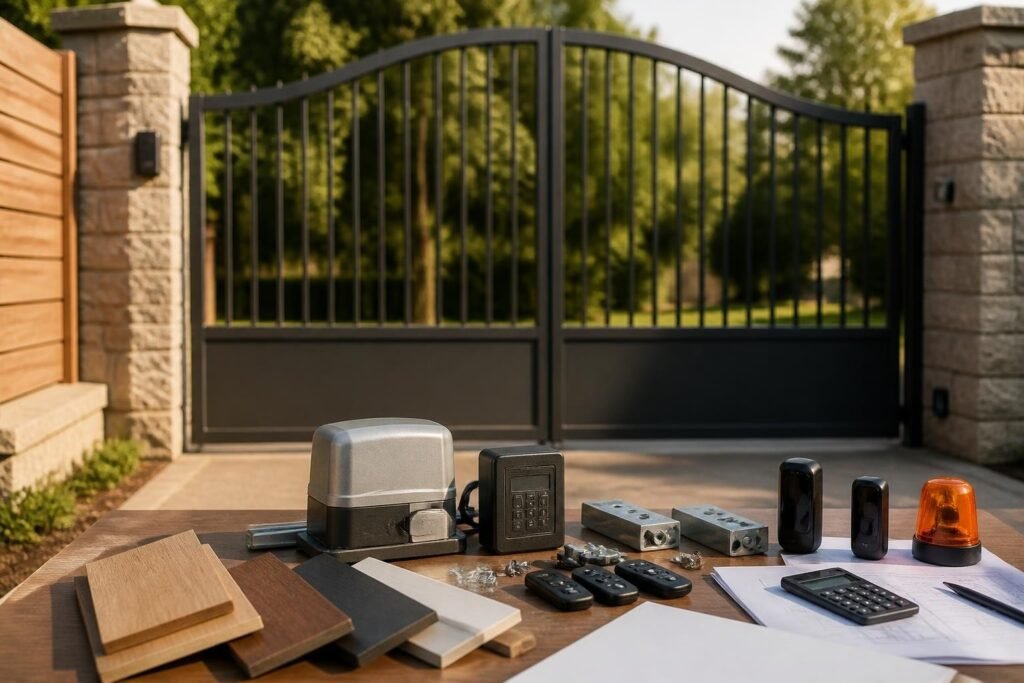
Understanding what goes into the cost of a gate requires more than just looking at a price tag. Whether you're planning a new driveway entrance, upgrading your commercial property's security, or replacing a failing gate system, dozens of factors influence the final investment. From material selection and automation features to local permit requirements and professional installation, every decision shapes your total budget. This comprehensive guide breaks down the components that determine gate pricing in 2026, helping property owners in Los Angeles and beyond make informed decisions about their access control needs.
Material Selection Drives Base Costs
The material you choose forms the foundation of your gate budget. Each option carries distinct price points, maintenance requirements, and longevity expectations.
Wood gates typically start between $300 and $4,000 depending on the species and craftsmanship. Cedar and redwood offer natural rot resistance but command premium prices. Pine and fir provide budget-friendly alternatives but require regular sealing and maintenance. Custom carpentry work for ornate wooden designs can push costs significantly higher.
Steel gates range from $600 to $6,000 based on gauge thickness and design complexity. Powder-coated steel resists corrosion better than paint, adding $200 to $500 to the initial investment but reducing long-term maintenance expenses. Wrought iron designs, while beautiful, often exceed $3,000 for materials alone due to the specialized fabrication required.
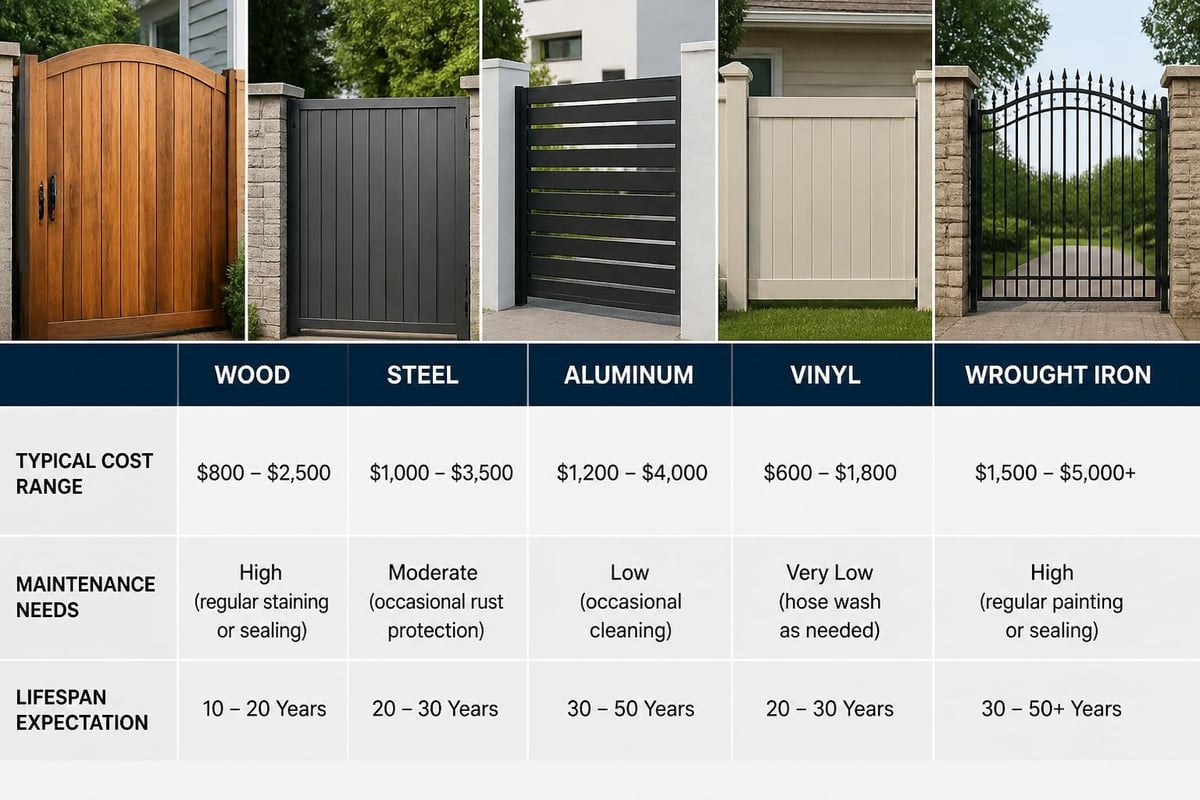
Aluminum gates occupy the $1,200 to $5,000 range, offering corrosion resistance without the weight of steel. This lighter weight reduces strain on automation systems and foundation requirements. Vinyl and composite materials, priced between $400 and $2,500, appeal to homeowners seeking minimal maintenance, though they may lack the security profile of metal alternatives.
Size and Configuration Impact Pricing
A single pedestrian gate measuring three to four feet wide costs substantially less than a double-swing driveway gate spanning twelve to twenty feet. According to HomeAdvisor’s gate installation cost data, width is one of the strongest predictors of total project expense.
| Gate Type | Typical Width | Material Cost Range | Total Installed Cost |
|---|---|---|---|
| Pedestrian | 3-4 feet | $200-$800 | $400-$1,500 |
| Single Swing | 10-14 feet | $600-$3,000 | $1,500-$6,000 |
| Double Swing | 12-20 feet | $1,200-$6,000 | $3,000-$12,000 |
| Sliding | 12-30 feet | $1,500-$8,000 | $4,000-$15,000 |
Sliding gates require track systems and extended clear space, adding $500 to $2,000 in specialized hardware beyond the gate panel itself. Their advantage in space-constrained driveways often justifies the additional investment for commercial properties and hillside homes.
Automation Systems Add Complexity and Cost
Manual gates represent the baseline cost, but automated systems deliver convenience, security, and property value that many owners consider essential. The cost of a gate increases substantially once you factor in motors, controls, and safety features.
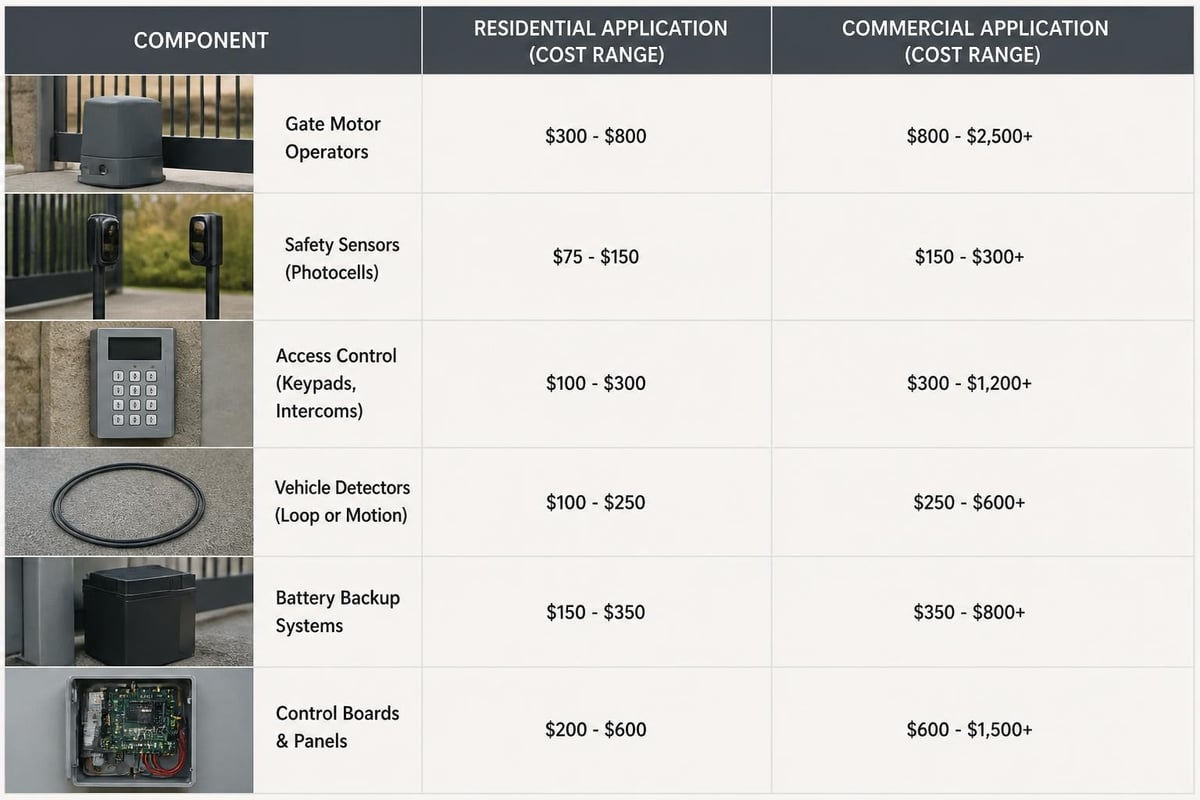
Basic gate operators start around $800 to $1,500 for residential swing gate applications. These units handle gates up to 500 pounds and include a standard wireless remote control. Commercial-duty operators designed for high-cycle use and heavier gates range from $2,000 to $5,000.
Sliding gate motors typically cost $1,200 to $3,500 depending on weight capacity and speed requirements. Chain-drive systems offer reliability at lower price points, while rack-and-pinion designs provide smoother, quieter operation at premium costs.
Safety features mandated by UL 325 standards for gate operators include photo-eye sensors ($150 to $300 per pair) and edge sensors ($200 to $500). These prevent the gate from closing on vehicles, people, or pets. Many Los Angeles properties require additional safety loops or monitored edge systems to meet local code requirements.
- Wireless keypads: $150-$400 for basic models, $500-$1,000 for smartphone-enabled systems
- Intercom systems: $300-$1,500 for audio, $800-$3,000 for video integration
- Vehicle sensors: $200-$600 for magnetic loops or infrared detection
- Battery backup: $300-$800 to maintain operation during power outages
- Solar panels: $400-$1,200 for off-grid gate locations
For properties seeking comprehensive automation, electric gate repair specialists can evaluate your existing infrastructure and recommend compatible upgrades that maximize value without requiring complete system replacement.
Access Control Integration
Modern gates often connect to broader security ecosystems. Smartphone control systems add $400 to $1,200 but allow remote operation and guest access management. Cloud-based platforms that integrate with surveillance cameras and alarm systems range from $800 to $2,500 for equipment, plus monthly subscription fees of $10 to $50.
Biometric readers using fingerprints or facial recognition represent the premium tier, starting at $1,500 and reaching $5,000 for commercial-grade multi-user systems. Vehicle tag readers that automatically open for authorized cars cost $600 to $2,000 per lane.
Installation Labor Varies by Project Scope
Professional installation typically represents 30% to 50% of the total cost of a gate project. Complexity, site conditions, and regional labor rates all influence this proportion.
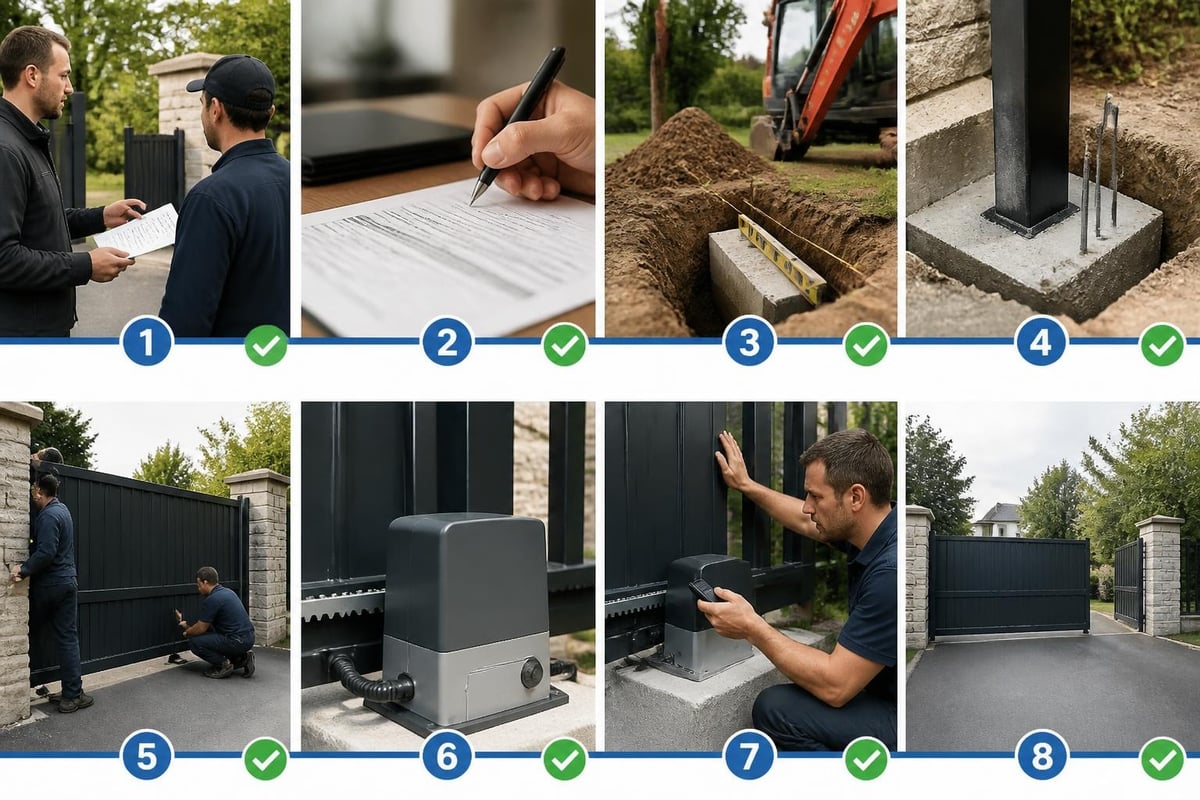
Basic installation of a pre-hung manual gate in existing posts might cost $300 to $800 in labor. This assumes level ground, accessible work areas, and no underground utility conflicts. Complex installations requiring new post installation, concrete work, and automation integration can demand $2,000 to $6,000 in labor charges.
Los Angeles-area installation rates generally run $75 to $150 per hour for licensed contractors. A typical automated driveway gate installation requires 12 to 24 hours of work, encompassing site preparation, foundation work, gate assembly, automation installation, and testing. Emergency or weekend installations may carry 50% to 100% premiums, though companies like Gates On Site offer same-day service without extra charges for urgent repairs.
Site Preparation Requirements
Uneven terrain, rocky soil, or sloped driveways increase excavation and foundation costs. Adding $500 to $2,000 to address these challenges is common. Concrete pier foundations for heavy gates require proper curing time, potentially extending project timelines and associated labor costs.
Electrical work for automated gates ranges from $400 to $1,500 depending on the distance from your main panel and local code requirements. Conduit must be buried at proper depths, junction boxes must meet weatherproof ratings, and circuits need appropriate amperage for motor loads. Licensed electricians in California typically charge $90 to $150 per hour for this specialized work.
As noted in BobVila’s driveway gate cost analysis, underground utility conflicts can add unexpected expenses. Relocating sprinkler lines, communication cables, or gas lines might add $300 to $2,000 to your project budget.
Permits, Codes, and Compliance Costs
Regulatory requirements influence the cost of a gate installation more than many property owners anticipate. Los Angeles County and municipal jurisdictions impose specific standards that affect design choices and associated expenses.
Building permits for automated gates typically cost $150 to $500 depending on the jurisdiction and project complexity. Permit fees cover plan review, inspections, and administrative processing. Commercial gates or those in historic districts may require additional architectural review, adding $300 to $1,000 in fees.
Code compliance drives several cost factors:
- Setback requirements may force gate placement that requires longer driveways or additional paving
- Fire access regulations can mandate specific gate widths, opening speeds, and emergency override systems
- ADA compliance for commercial properties requires specific clearances and operating forces as outlined in ADA accessibility standards
- Historic preservation rules in designated areas may restrict materials and designs
Meeting ASTM F2200 standards for automated vehicular gate construction ensures your gate is properly classified and constructed for its intended use. These standards define four classes of gates based on usage intensity, from occasional residential use to continuous commercial operation. Higher-class gates require more robust construction, driving material and labor costs upward.
Fire department access requirements, particularly for gated communities and commercial properties, may mandate Knox box systems ($300 to $600), emergency breakaway gates ($1,500 to $4,000), or monitored emergency access systems ($2,000 to $8,000). The National Fire Protection Association provides guidance on these requirements, which vary by jurisdiction and property classification.
Hidden Costs and Long-Term Considerations
Beyond the obvious expenses, several factors affect the true cost of a gate over its lifespan. Accounting for these elements prevents budget surprises and ensures sustainable ownership.
Foundation work often exceeds initial estimates when soil conditions prove challenging. Clay soils that expand and contract with moisture require deeper footings or specialized pier designs. Rocky substrates might need drilling or blasting. These situations can add $800 to $3,000 to project costs.
Utility relocation becomes necessary when underground lines conflict with gate posts or track systems. Gas, water, electric, and communication lines all require professional relocation at costs ranging from $500 to $3,000 per utility depending on depth and complexity.
Maintenance and Operating Expenses
Annual maintenance for automated gates typically costs $200 to $600, covering lubrication, adjustment, safety sensor testing, and minor repairs. Neglecting this maintenance often leads to premature failures and costly emergency repairs.
Common replacement items over a gate's lifespan include:
| Component | Typical Lifespan | Replacement Cost |
|---|---|---|
| Gate operator motor | 10-15 years | $800-$3,500 |
| Control board | 8-12 years | $300-$900 |
| Photo-eye sensors | 5-8 years | $150-$300 per pair |
| Remote controls | 3-5 years | $40-$120 each |
| Battery backup | 3-5 years | $150-$400 |
| Hinges/bearings | 15-20 years | $200-$800 |
Electricity costs for automated gates are modest, typically $3 to $8 monthly for residential systems. Solar-powered systems eliminate this recurring cost but require panel cleaning and battery replacement every five to seven years at $400 to $800.
For properties with aging gate systems, professional gate repair services can often extend equipment life at a fraction of replacement cost, making proper maintenance a wise investment.
Insurance and Liability Factors
Property insurance considerations affect both initial installation decisions and long-term costs. Understanding coverage gaps helps prevent financial exposure.
Standard homeowners policies, as detailed by the Insurance Information Institute, typically cover gates as part of "other structures" coverage, usually 10% of dwelling coverage. A home insured for $500,000 would have $50,000 in other structures coverage, generally sufficient for most residential gate installations.
Liability concerns drive several cost decisions. Gates that fail to meet safety standards or lack proper photo-eyes and edge sensors create liability exposure if accidents occur. Installing UL 325-compliant systems with proper safety features costs more initially but protects property owners from negligence claims.
Commercial property policies may require specific gate certifications, particularly for parking facilities, storage yards, or multi-family housing. Meeting these insurance requirements often mandates commercial-grade operators, monitored safety systems, and regular professional inspections, each adding to both initial and ongoing costs.
Some insurers offer premium discounts for automated gates that enhance security, typically 2% to 5% on property insurance. For commercial properties in high-crime areas, these discounts can offset a portion of the automation investment over time.
Geographic and Market Variations
The cost of a gate varies significantly by location due to labor rates, material availability, and local market conditions. Los Angeles represents a higher-cost market compared to national averages.
Southern California labor rates exceed national averages by 15% to 30% for skilled trades. Material delivery to remote areas within Los Angeles County may add $100 to $500 in freight charges. Conversely, the competitive Los Angeles market offers numerous qualified installers, which can create pricing pressure that benefits consumers.
Seasonal factors influence pricing and availability. Spring and early summer represent peak installation seasons when contractors often charge premium rates and face extended lead times. Scheduling installation during fall or winter months can yield 10% to 20% cost savings through reduced demand.
Economic cycles affect material costs substantially. Steel and aluminum prices fluctuate with commodity markets, creating price variations of 20% to 40% year-over-year. Locking in material costs early through deposits or contracts protects against mid-project price increases.
The NAIC homeowners insurance market reports indicate that insurance availability and requirements vary by region, affecting gate installation standards and associated costs in different markets.
Municipal and County-Specific Requirements
Los Angeles County encompasses numerous municipalities, each with distinct requirements. Beverly Hills enforces strict aesthetic standards that may require custom fabrication, increasing costs by 30% to 50% compared to standard designs. Coastal areas impose corrosion-resistant material requirements that favor aluminum or stainless steel over standard painted steel.
Public-sector projects provide cost benchmarking data. Florida DOT’s historical cost averages offer insight into institutional gate procurement costs, though California projects typically run 20% to 40% higher due to prevailing wage requirements and stricter environmental regulations.
Comparing DIY Versus Professional Installation
Cost-conscious property owners often consider self-installation to reduce expenses. Understanding the true savings and risks helps inform this decision.
DIY gate installation can save 30% to 50% of total project cost by eliminating labor charges. A gate system with $3,000 in materials might cost $5,000 installed professionally but only $3,500 if you provide the labor. However, this assumes you have the necessary skills, tools, and time.
Required tools for proper gate installation include:
- Post hole digger or auger ($50-$300 rental)
- Level and transit ($100-$400 purchase or rental)
- Concrete mixer ($80-$150 rental)
- Drill and impact driver ($150-$400)
- Welding equipment for metal fabrication ($300-$2,000)
- Conduit bending and electrical tools ($100-$300)
Tool rental and purchase alone can approach $500 to $1,000 for a single project. Time investment typically spans three to five full days for homeowners versus one to two days for experienced professionals.
Critical challenges in DIY installation include:
- Achieving perfectly plumb and aligned posts for smooth gate operation
- Properly sizing and pouring concrete footings to prevent settling
- Correctly wiring automation systems to meet electrical codes
- Programming and adjusting safety sensors to UL 325 standards
- Troubleshooting operational issues without diagnostic tools
Mistakes in these areas often require professional correction at costs exceeding the initial savings. Additionally, self-installed gates may not pass inspection, requiring rework and reinspection fees.
For property owners comfortable with complex projects, purchasing pre-fabricated gate kits ($800 to $4,000) and hiring professionals only for concrete work and electrical connections represents a middle path. This hybrid approach can reduce total costs by 20% to 30% while ensuring critical components meet code requirements.
Value Engineering Strategies
Smart cost management maintains quality while controlling the cost of a gate installation through strategic choices and timing.
Phased implementation allows property owners to install a manual gate initially and add automation later when budget permits. This approach spreads costs over time, though it may result in 10% to 15% higher total expenses than integrating everything from the start. Pre-wiring for future automation during initial installation minimizes this premium.
Material substitutions offer cost savings without major functional compromises. Powder-coated steel instead of wrought iron saves 30% to 40% while delivering similar aesthetics and durability. Aluminum frames with decorative panels create upscale appearances at mid-tier prices.
Standardized designs cost significantly less than custom fabrication. Choosing from manufacturer standard patterns and sizes reduces production time and eliminates custom tooling charges that can add 25% to 50% to material costs.
Competitive Bidding Approaches
Obtaining three to five detailed quotes reveals market pricing and identifies outliers. Quotes should itemize materials, labor, permits, and specific equipment models to enable meaningful comparison. Unusually low bids may indicate substandard materials, unlicensed labor, or missing components like safety sensors.
Contractor qualifications matter more than lowest price. Licensed contractors provide warranty protection and carry liability insurance that protects property owners from jobsite accidents. Verifying contractor licensing, insurance, and references prevents costly mistakes.
Bundling multiple projects can yield discounts. Installing gates at the same time as fencing work or driveway paving allows contractors to reduce mobilization costs and may earn 10% to 15% price reductions on combined projects.
Commercial Versus Residential Cost Differences
Commercial gates face higher performance demands and regulatory requirements that substantially increase costs compared to residential installations.
Duty cycle ratings differentiate residential gates (30-50 operations daily) from commercial systems (100-500+ operations daily). Commercial-duty operators cost two to three times residential models but provide the reliability high-traffic applications demand. Using residential equipment in commercial settings leads to premature failure and frequent downtime.
Safety requirements escalate for commercial applications. Monitored edge sensors, dual photo-eyes, vehicle presence loops, and emergency stop buttons add $800 to $2,500 in safety equipment beyond basic residential standards. As outlined in ASTM F2630 self-closing gate guidance, commercial facilities may require self-closing mechanisms that add further complexity and cost.
| Feature | Residential Gate | Commercial Gate |
|---|---|---|
| Average total cost | $3,000-$8,000 | $8,000-$25,000 |
| Operator duty rating | 30-50 cycles/day | 100-500 cycles/day |
| Safety sensors | Basic photo-eyes | Monitored redundant systems |
| Expected lifespan | 15-20 years | 20-30 years (maintained) |
| Annual maintenance | $200-$400 | $600-$1,500 |
Access control integration for commercial properties often connects to enterprise systems managing multiple entry points, parking validation, and visitor management. These integrated systems start at $5,000 and can exceed $30,000 for large facilities with sophisticated requirements.
Emergency access provisions for fire departments and emergency services add costs through Knox boxes, breakaway systems, or constantly monitored emergency controls. These features ensure code compliance but contribute $1,000 to $5,000 to project budgets.
Financing and Payment Considerations
Funding gate installations involves various options that affect total cost through interest and fees.
Cash payment avoids financing charges but depletes liquidity. For projects exceeding $5,000, many property owners prefer preserving cash for emergencies and utilizing financing options.
Home equity lines of credit (HELOCs) offer competitive interest rates (currently 7% to 10% in 2026) and tax-deductible interest for qualified borrowers. A $10,000 gate financed through a HELOC at 8% over five years costs approximately $11,200 total, adding $1,200 in interest expense.
Contractor financing through third-party lenders provides convenience but typically carries higher rates (12% to 25% APR). A $10,000 project financed at 18% over three years costs $12,900 total. Promotional periods offering deferred interest require careful attention to payment deadlines to avoid retroactive interest charges.
Property assessed clean energy (PACE) financing, available in some California jurisdictions, allows energy-efficient improvements to be repaid through property tax assessments over 10 to 20 years. Solar-powered gates may qualify, offering low rates (6% to 8%) and longer terms that reduce monthly payment pressure.
Return on Investment Factors
Gate installations provide both functional benefits and property value enhancement. Automated driveway gates typically return 50% to 70% of installation cost in added property value according to real estate professionals. Security enhancements appeal particularly to luxury home buyers and families with young children.
Operating cost reductions from solar-powered systems provide measurable savings. A $1,200 solar installation eliminates $50 to $100 annually in electricity costs, creating a 12- to 24-year payback period. Combined with property value gains and security benefits, the total value proposition often justifies the investment.
Commercial properties benefit from reduced security labor costs, unauthorized entry prevention, and improved professional appearance. A retail facility spending $20,000 on automated access control might eliminate a full-time security position, creating annual savings of $35,000 to $50,000 that justify the investment within six months.
Understanding the many components that determine the cost of a gate empowers property owners to make informed decisions aligned with their needs and budgets. From material selection and automation features to permits, installation, and long-term maintenance, each factor contributes to your total investment. Whether you need gate motor repair services for an existing system or are planning a complete installation, professional guidance ensures your project delivers lasting value. Gates On Site brings over 20 years of experience to residential and commercial gate projects throughout Los Angeles, offering same-day service and expert advice to help you navigate every aspect of gate ownership.