
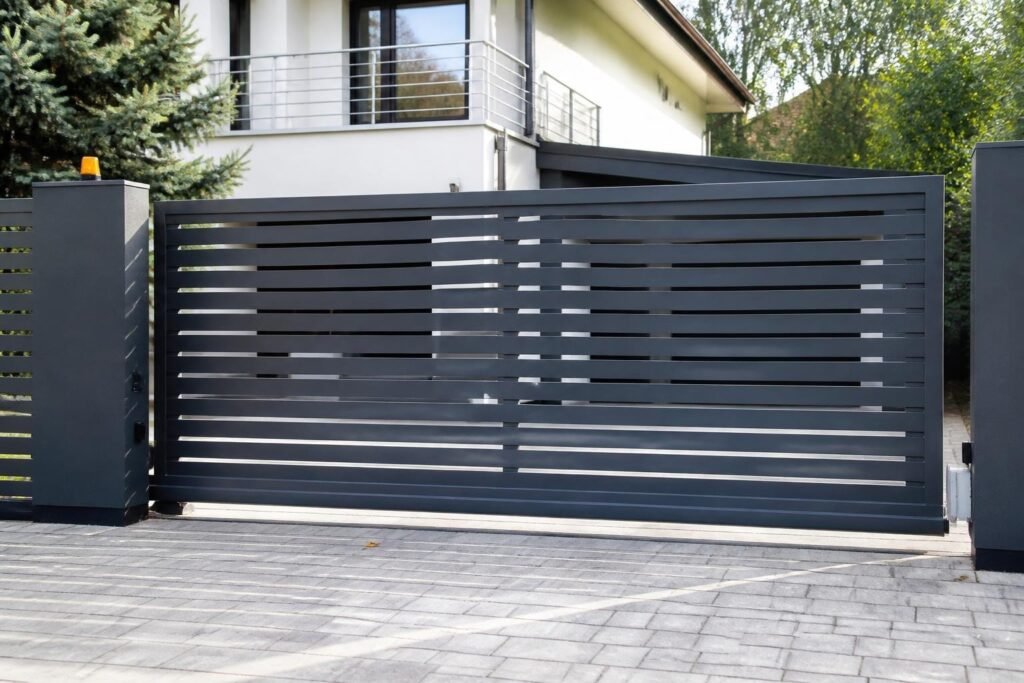
Choosing the right entrance solution for your property requires careful consideration of security, aesthetics, durability, and functionality. Metal gates for driveways have become the preferred choice for residential and commercial properties across Los Angeles, offering unmatched strength, design versatility, and long-term value. Whether you're securing a hillside estate in the Hollywood Hills or protecting a commercial facility in the Valley, understanding the full spectrum of metal gate options, materials, automation systems, and maintenance requirements helps you make an informed investment that serves your property for decades.
Understanding Metal Gate Materials and Their Properties
The foundation of any quality driveway gate begins with material selection. Each metal type brings distinct advantages in terms of strength, corrosion resistance, maintenance needs, and aesthetic possibilities.
Steel gates dominate the commercial and high-security residential market. Available in hollow structural sections, solid bars, or decorative wrought-iron styles, steel provides exceptional strength-to-weight ratios and impact resistance. According to worldsteel’s lifecycle inventory data, modern steel production has significantly reduced embodied carbon, making it an increasingly sustainable choice for metal gates for driveways. Hot-rolled steel offers maximum structural integrity for heavy gates, while cold-rolled steel provides tighter tolerances for precision fabrication.
Aluminum Gate Advantages
Aluminum presents compelling benefits for coastal and corrosive environments. The material naturally forms a protective oxide layer that resists rust without additional treatment. Aluminum gates weigh approximately one-third as much as comparable steel designs, reducing stress on automation systems and mounting hardware.
- Ideal for salt-air exposure in coastal areas
- Requires less powerful operators due to reduced weight
- Accepts powder coating exceptionally well
- Lower maintenance intervals compared to steel
- Higher initial material cost offset by longevity
Wrought iron, though technically mild steel worked into decorative patterns, deserves separate consideration. Traditional wrought-iron metal gates for driveways combine old-world craftsmanship with modern welding techniques and protective powder coating systems that prevent the rust issues that plagued earlier generations.
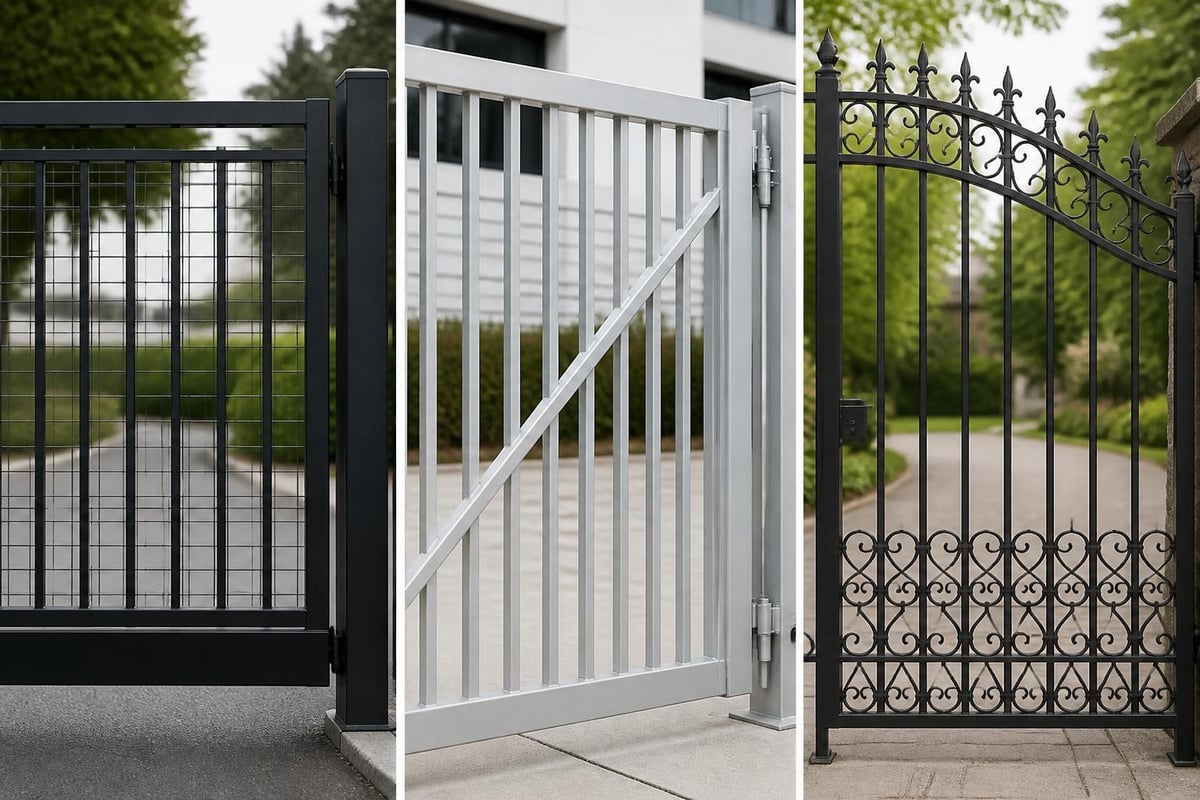
Configuration Options: Swing vs. Sliding Systems
Gate configuration fundamentally affects installation requirements, space utilization, and operational reliability. The choice between swing and slide mechanisms depends on your driveway geometry, traffic patterns, and site conditions.
Swing gates operate like traditional doors, pivoting on hinges mounted to sturdy posts or columns. Single-swing gates work well for openings up to 16 feet, while dual-swing configurations handle entrances up to 30 feet wide. The primary consideration is swing clearance-you need adequate space on the property side for gates to open fully without striking vehicles, landscaping, or structures.
| Configuration | Ideal Opening Width | Space Requirements | Slope Tolerance | Typical Application |
|---|---|---|---|---|
| Single Swing | 8-16 feet | Arc clearance inside property | Up to 8° grade | Residential driveways |
| Dual Swing | 16-30 feet | Bilateral arc clearance | Up to 5° grade | Estate entrances |
| Cantilever Slide | 12-40 feet | Run-back space 1.5× opening | Up to 10° grade | Commercial facilities |
| Track Slide | 8-30 feet | Run-back space 1× opening | Must be level | Level driveways |
Sliding gates eliminate swing clearance concerns by traveling parallel to the fence line. Cantilever systems suspend the gate above the driveway on a wheeled carriage, avoiding ground tracks that can collect debris or ice. Track-mounted slides cost less initially but require meticulous leveling and regular track cleaning.
For properties with sloped driveways-common throughout Los Angeles hillside neighborhoods-automatic gate repair specialists often recommend cantilever configurations that accommodate grades up to 10 degrees without compromising operation.
Automation Systems and Access Control Integration
Modern metal gates for driveways incorporate sophisticated automation that balances convenience, security, and safety compliance. Gate operators have evolved dramatically since early chain-drive systems, now offering solar power options, battery backup, and smartphone integration.
Operator Selection Criteria
Choosing the right operator requires calculating gate weight, wind load, and duty cycle. Residential systems typically operate 10-20 cycles daily, while commercial installations may exceed 100 cycles. Underpowered operators experience premature wear; oversized units waste energy and create unnecessarily aggressive movement.
Solar-powered operators have gained popularity for remote locations and environmentally conscious installations. The Department of Energy’s compliance reports document successful implementations combining solar panels, battery banks, and electronic access controls for off-grid gate systems that maintain full functionality during power outages.
Safety compliance has tightened considerably in recent years. UL 325 certification requirements mandate entrapment protection systems including photoelectric sensors, pressure-sensitive edges, and inherent force limiting. The American Fence Association’s announcement regarding new gate safety provisions in the 2027 I-Codes emphasizes the industry's shift toward proactive safety features that prevent accidents before they occur.
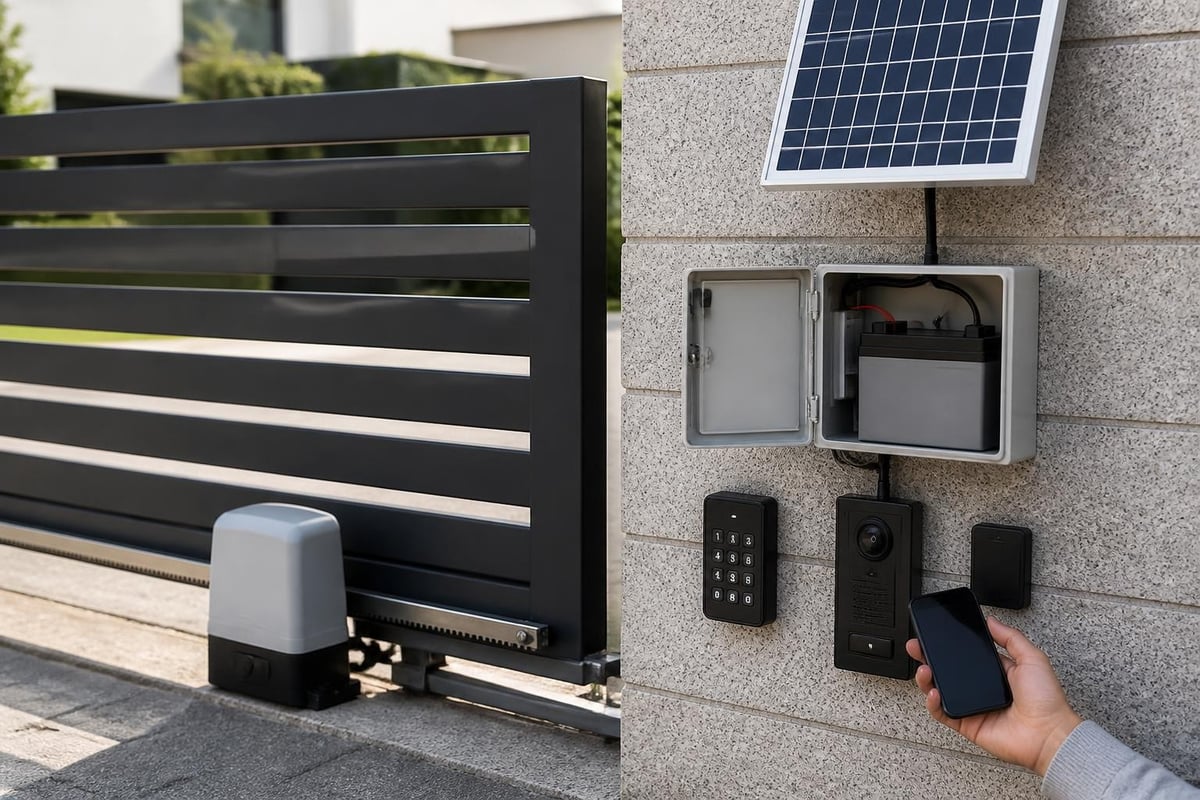
Access control options range from simple keypads to sophisticated biometric systems:
- Wireless keypads offer affordable security with user-programmable codes
- RFID card readers provide traceable access for employees and residents
- Smartphone apps enable remote operation and visitor management
- Video intercoms combine visual verification with gate release
- License plate recognition automates entry for registered vehicles
- Biometric scanners deliver maximum security for sensitive facilities
For high-security commercial applications requiring vehicle barrier systems, CISA’s guide on active and passive vehicle barriers provides comprehensive design criteria where metal gates for driveways serve as the first layer in a multi-tiered perimeter security approach.
Design Considerations and Aesthetic Integration
Metal gates serve dual roles as security barriers and architectural statements. The design should complement your property's character while meeting functional requirements.
Architectural Style Matching
Mediterranean and Spanish Colonial homes prevalent in Los Angeles pair naturally with ornate wrought-iron designs featuring scrollwork, spear points, and arched tops. Contemporary properties benefit from clean-lined aluminum or steel gates with horizontal slats, geometric patterns, or perforated panels. Craftsman-style homes find harmony in simpler ironwork with straight pickets and minimal ornamentation.
Privacy requirements influence infill patterns. Solid-panel gates provide complete visual screening but increase wind loading and operator demands. Vertical bar spacing at 4 inches or less prevents child passage while maintaining visibility. Decorative inserts-laser-cut patterns, custom monograms, or artistic metalwork-personalize the entrance without compromising security.
Color and finish selection dramatically affects both appearance and longevity. Powder coating offers superior durability compared to liquid paint, with UV-stable formulations resisting fading in California's intense sun. Popular choices include:
- Textured black: Timeless elegance that conceals minor imperfections
- Bronze tones: Warm complement to earth-tone architecture
- Metallic grays: Contemporary aesthetic with excellent heat reflection
- Custom colors: Matched to trim, shutters, or branding elements
The International Code Council’s property maintenance provisions outline minimum standards for gate condition, finish integrity, and operational safety that property owners must maintain to avoid code violations.
Installation Requirements and Site Preparation
Proper installation determines whether metal gates for driveways operate reliably for decades or require constant adjustment. Foundation work, post setting, and electrical infrastructure must meet engineering standards specific to your gate's weight and wind exposure.
Foundation and Post Engineering
Gate posts bear enormous stress from gate weight, wind force, and daily operational cycles. Concrete foundations typically extend 36-48 inches below grade with minimum dimensions of 18×18 inches for residential gates. Commercial installations or gates exceeding 500 pounds may require engineered pier foundations extending to stable soil or bedrock.
Steel posts set in concrete provide maximum strength. Wall thickness should be specified based on gate weight and leverage-heavier gates demand thicker-wall tubing to resist deflection. Proper embedment depth prevents the gradual leaning that plagues inadequately anchored posts.
Column-mounted gates integrate with masonry pillars or decorative columns. Embedding plates must be specified during column construction, with reinforcing steel tying the plate to the column's structural core. Retrofit mounting to existing columns requires careful engineering to avoid compromising structural integrity.
Electrical planning encompasses more than running power to the operator. Professional installations include:
- Underground conduit runs using schedule 40 PVC
- Dedicated circuit protection with GFCI where required
- Emergency disconnect accessible without crossing gate path
- Surge protection for control boards and access devices
- Battery backup systems for critical-access locations
When selecting electric gate opener systems, matching operator voltage (12V, 24V, or 120V AC) to your power availability and backup requirements prevents compatibility issues down the road.
Maintenance Protocols and Longevity Optimization
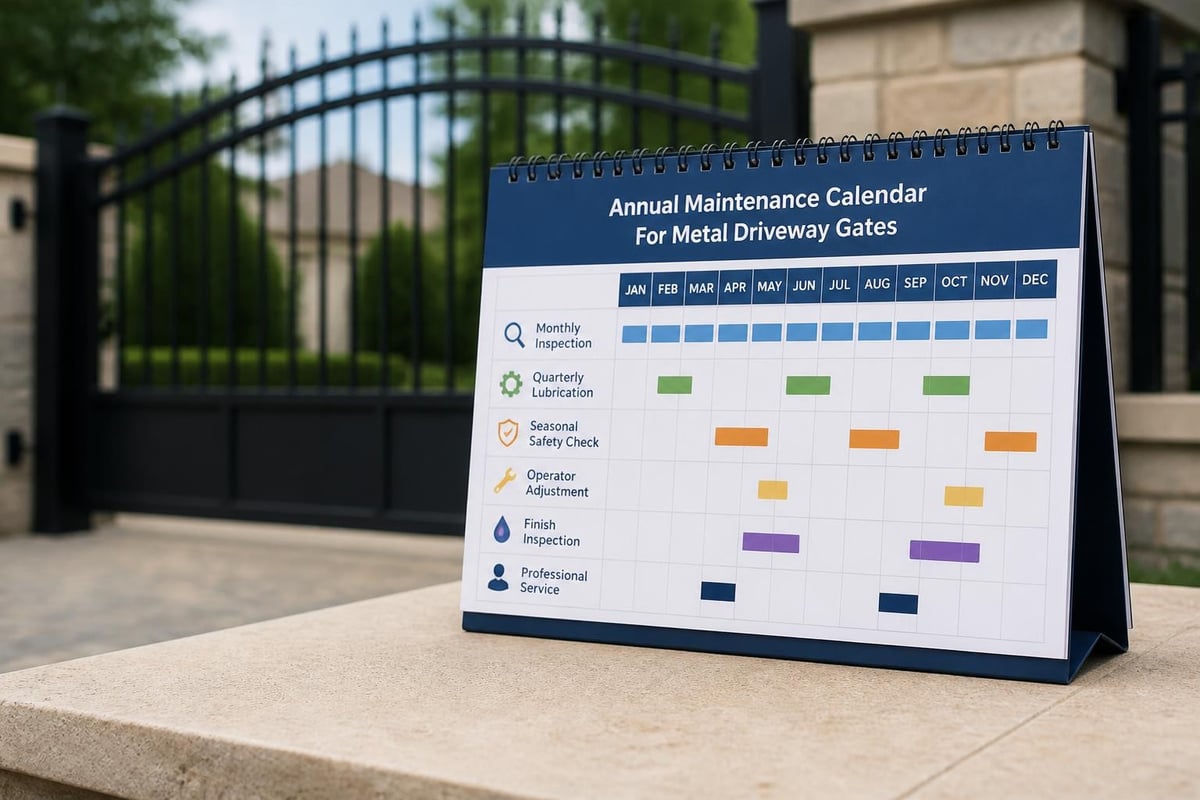
Even the highest-quality metal gates for driveways require systematic maintenance to deliver decades of reliable service. Establishing a routine inspection and service schedule prevents minor issues from escalating into expensive repairs.
Quarterly Inspection Checklist
Every three months, property owners or maintenance teams should conduct thorough visual and operational assessments:
- Hinge points: Check for wear, proper lubrication, and mounting security
- Roller carriages: Inspect wheels for flat spots, bearing wear, and track alignment
- Welded joints: Look for cracks, rust bloom, or separation
- Finish condition: Note any coating damage, rust formation, or UV degradation
- Hardware tightness: Verify all bolts, screws, and fasteners remain secure
- Safety devices: Test photo eyes, pressure edges, and emergency stops
- Operational smoothness: Listen for unusual sounds indicating misalignment
Lubrication prevents premature wear and ensures smooth operation. Use white lithium grease on hinges, chain drives, and sliding tracks. Avoid petroleum-based lubricants that attract dust and debris. Operator gearboxes should be checked annually and serviced according to manufacturer specifications.
| Maintenance Task | Frequency | DIY-Friendly | Professional Required |
|---|---|---|---|
| Visual inspection | Monthly | Yes | No |
| Lubrication | Quarterly | Yes | No |
| Safety sensor test | Monthly | Yes | No |
| Finish touch-up | As needed | Yes | No |
| Operator adjustment | Annually | No | Yes |
| Welding repair | As needed | No | Yes |
| Complete refinishing | 5-7 years | No | Yes |
Corrosion protection represents the most critical long-term maintenance concern, especially in coastal areas where salt air accelerates oxidation. Annual washing with mild detergent removes corrosive deposits. Touch-up painting should address any finish damage immediately-once rust begins, it spreads rapidly beneath intact coating.
For properties with electric motor gate openers, electronic component maintenance includes cleaning control boards, testing capacitors, and verifying proper voltage throughout the system. Circuit boards exposed to temperature extremes or moisture develop premature failures that professional diagnostics can often catch before complete breakdown.
Cost Analysis and Return on Investment
Understanding the total cost of ownership for metal gates for driveways requires looking beyond initial purchase price to installation, automation, maintenance, and eventual replacement or refurbishment.
Initial Investment Breakdown
Entry-level steel swing gates for standard residential driveways begin around $1,200-$2,500 for the gate itself. Custom wrought-iron designs range from $3,000-$8,000 depending on complexity and size. Commercial-grade sliding gates often start at $5,000-$10,000 before automation.
Installation costs vary dramatically based on site conditions. Simple installations with existing posts and nearby power may add $800-$1,500. Complex projects requiring concrete work, trenching, electrical permits, and masonry columns can exceed $5,000 in labor alone. When considering the cost of a gate system, factor in these installation variables to avoid budget surprises.
Automation adds $1,500-$4,000 depending on operator quality, access control sophistication, and safety features. Solar systems command a premium but eliminate ongoing electrical costs and provide independence from grid power.
Long-term value calculations should account for:
- Property value increase: Quality gates enhance curb appeal and security, typically returning 70-90% of investment in resale value
- Insurance benefits: Some carriers offer premium reductions for gated properties
- Energy costs: Solar operators eliminate electrical draw; standard operators consume $2-5 monthly
- Maintenance expenses: Budget $150-400 annually for professional service
- Replacement timeline: Well-maintained metal gates last 25-40 years before requiring replacement
Commercial properties see additional ROI through reduced security staffing, decreased vehicle theft, and improved liability protection. Gates control who enters premises, creating traceable access logs that support security investigations and reduce unauthorized entry.
Troubleshooting Common Operational Issues
Even properly installed and maintained metal gates for driveways occasionally develop operational problems. Recognizing symptoms and understanding probable causes enables faster resolution and prevents secondary damage.
Intermittent Opening or Closing
Gates that work sometimes but fail unpredictably often suffer from:
- Weak batteries in wireless access devices or backup systems
- Corroded connections causing intermittent power delivery
- Overheating operators cycling on thermal protection
- Interference affecting wireless controls or sensors
- Software glitches in programmable control boards
Testing voltage at the operator during failure episodes helps isolate electrical issues. Wireless interference often correlates with neighbor's garage door usage or nearby commercial radio equipment.
Excessive Noise During Operation
Metal gates should operate relatively quietly. Grinding, squealing, or banging indicates mechanical problems:
- Metal-on-metal contact from worn rollers or hinges
- Loose hardware allowing components to shift during movement
- Chain or belt wear in drive mechanisms
- Bearing failures in wheels or operator gearboxes
- Misalignment causing binding at certain points in travel
Immediate lubrication may temporarily quiet some noises, but persistent sounds warrant professional diagnosis before wear accelerates into component failure. When gates serving Los Angeles properties develop operational issues, experienced automatic gate repair technicians can typically diagnose and resolve problems during a single service call.
Slow Response or Sluggish Movement
Gates that open slowly or struggle against resistance face either mechanical drag or insufficient power:
- Operator undersized for gate weight or increased friction
- Binding hinges or rollers creating excessive resistance
- Debris accumulation in tracks or wheel paths
- Voltage drop from corroded wiring or weak batteries
- Cold weather increasing lubricant viscosity
Testing gate movement with operator disconnected reveals whether resistance stems from mechanical binding or power delivery issues. Gates should move smoothly with minimal manual force when the operator is disengaged.
Code Compliance and Safety Regulations
Metal gates for driveways must comply with increasingly stringent safety standards designed to prevent entrapment injuries and property damage. Understanding applicable codes prevents costly retrofits and liability exposure.
Recent updates to the International Building Code and International Fire Code, effective in many jurisdictions for 2027, incorporate enhanced gate safety requirements. These provisions mandate:
- Photoelectric sensors across the full gate travel path
- Pressure-sensitive edges on leading edges of powered gates
- Maximum closing force limits preventing injury from contact
- Manual release mechanisms accessible without tools
- Warning signage alerting users to automatic operation
- Emergency vehicle access provisions for fire department override
Fire code compliance particularly affects commercial properties and gated communities. Emergency responders require reliable access during emergencies, typically through Knox boxes, fire department master keys, or radio-activated gate releases. Designing systems that balance security with emergency access requires careful planning and coordination with local authorities.
Residential installations face fewer regulatory requirements but must still meet UL 325 standards for inherent safety. Operators must detect obstructions and reverse automatically when encountering unexpected resistance. Annual testing verifies these safety features function correctly-a critical inspection that many property owners overlook until accidents occur.
Enhancing Security Through Design and Technology
While all metal gates for driveways provide baseline security by controlling access, specific design choices and technology integrations dramatically enhance protective capabilities.
Physical Security Features
The gate itself can incorporate anti-climb and forced-entry resistance:
- Spear-point finials deter climbing attempts
- Minimal horizontal elements eliminate hand/foot holds
- Heavy-gauge construction resists cutting and prying
- Continuous welding eliminates weak fastener points
- Anti-lift hinges prevent gate removal from pins
Bollards or concrete barriers flanking the gate prevent vehicles from bypassing the entrance by crossing adjacent landscaping. For high-security applications, gates certified to crash-rating standards can stop vehicles traveling at specified speeds.
Surveillance integration transforms gates from passive barriers into active security nodes. Cameras positioned at gate entrances capture every vehicle and visitor. Modern IP cameras offer:
- License plate recognition for automated access decisions
- Facial recognition for resident/employee verification
- Cloud recording for extended retention periods
- Remote monitoring through smartphone apps
- Integration with whole-property security platforms
Motion sensors and ground loops detect approaching vehicles, triggering cameras to record and alerting property owners to arrival activity. These systems create comprehensive access logs documenting who entered, when, and whether entry was authorized.
Selecting and maintaining the right metal gates for driveways requires balancing security needs, aesthetic preferences, automation technology, and long-term durability considerations specific to your Los Angeles property. Whether you're installing a new gate system or maintaining an existing installation, professional expertise ensures reliable operation and maximum return on your investment. Gates On Site brings over 20 years of experience to residential and commercial gate challenges throughout Los Angeles, offering same-day service for repairs, automation upgrades, and system optimization-keeping your entrance secure and operating smoothly year after year.