
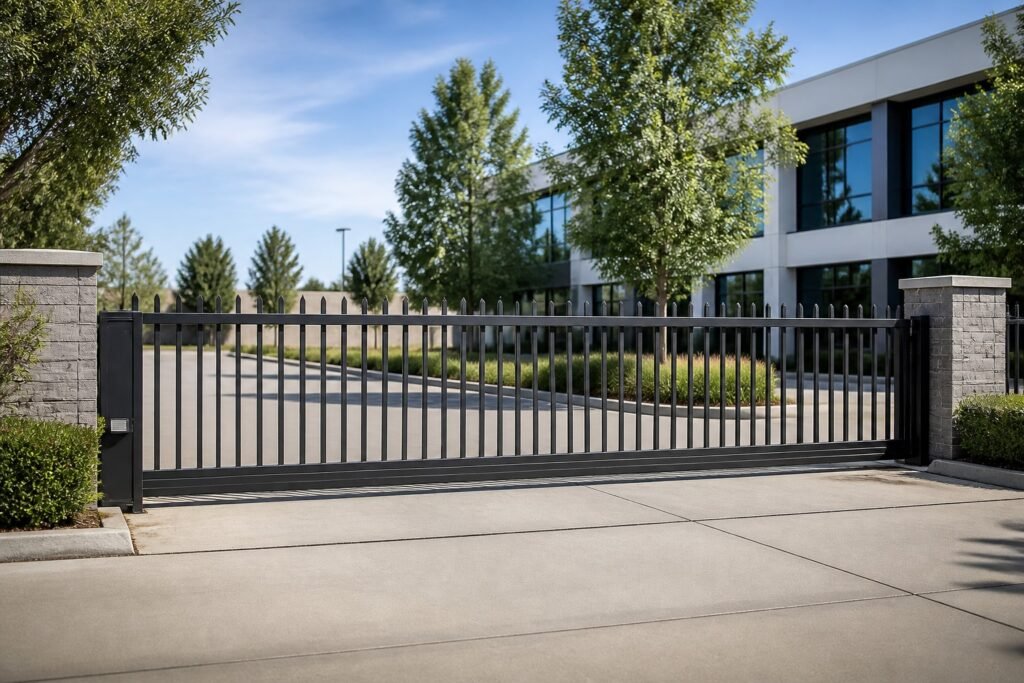
Commercial automatic gates are motorized barriers that open and close on a command from a keypad, card reader, remote, intercom or vehicle sensor, and they control who enters a business property, when, and at what speed. For Los Angeles businesses, the right choice depends on traffic volume, available space, security needs, and compliance with UL 325 safety requirements. This guide covers gate types, operator selection, costs, downsides, code rules and the maintenance habits that keep a gate working for years.
What Is an Automatic Gate and How Does It Work?
An automatic gate, sometimes called an autogate, is a gate leaf driven by an electric operator rather than by hand. The operator receives a signal from an access device, drives the gate open, waits, then closes it, usually after a timer expires or a loop detector confirms the vehicle has cleared.
Every system has the same core parts:
- Gate leaf or panel: steel, aluminum or wrought iron, built to fit the opening.
- Operator (motor): hydraulic or electromechanical, matched to gate weight and duty cycle.
- Control board: the logic unit that sets speed, force limits and timing.
- Access devices: keypads, RFID readers, remotes, intercoms, phone apps.
- Safety devices: photo eyes, edge sensors and inductive loops.
When one of these parts fails, the whole entrance stops. Most commercial service calls trace back to the control board, a worn operator or a misaligned safety sensor rather than the gate itself.
Which Types of Commercial Automatic Gates Fit a Business?
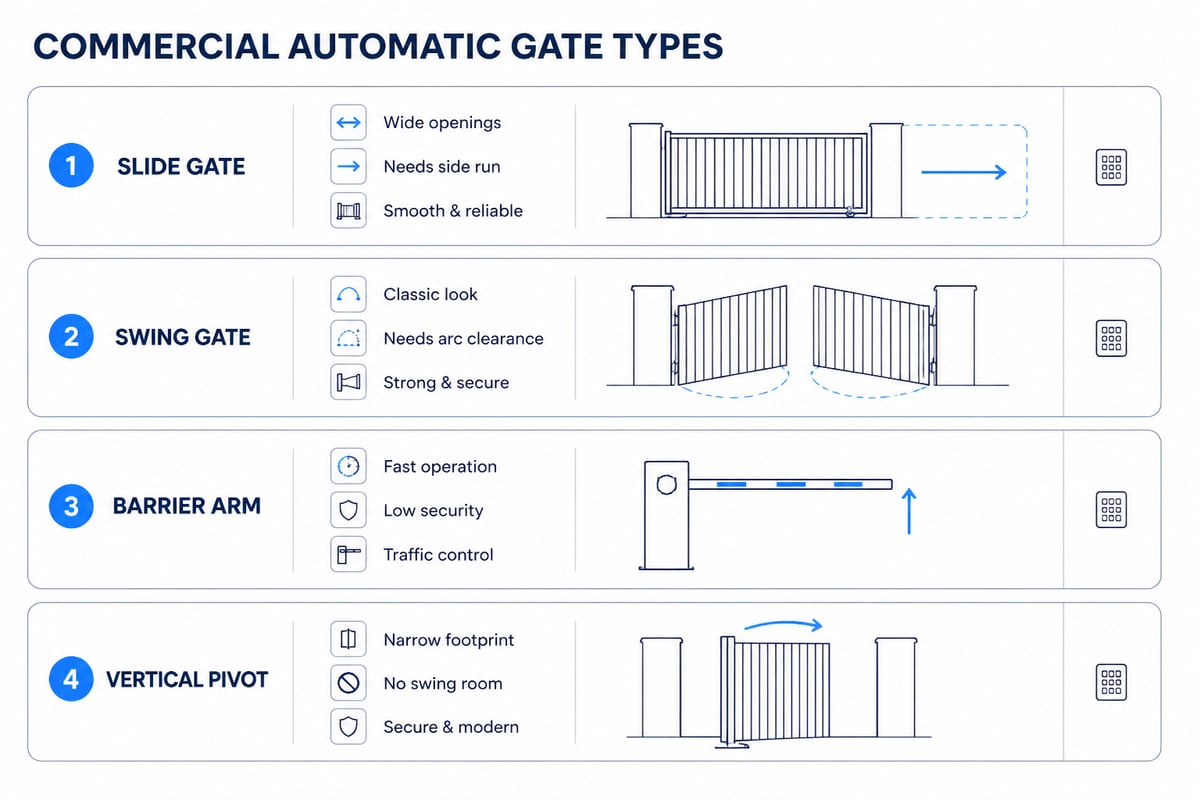
Four main designs cover most commercial properties, and the right one is set by available space, vehicle traffic and security requirements.
| Gate type | Best fit | Space needed | Speed |
|---|---|---|---|
| Slide gate | Warehouses, lots, industrial yards | Clear run beside the opening | Moderate |
| Swing gate | Offices, retail, tight-traffic entries | Arc clearance inward or outward | Moderate |
| Barrier arm | Parking facilities, high-turnover lots | Minimal | Fast |
| Vertical pivot gate | Sites with no side or swing room | Overhead and narrow footprint | Moderate |
Slide gates dominate Los Angeles industrial corridors because they handle wide openings and resist forced entry well. Swing gates suit properties with a setback from the street, since the leaf needs room to travel. Barrier arms move vehicles quickly but offer little security on their own, so they are often paired with a fence or a secondary gate. Vertical pivot gates lift the leaf up and over, which helps on narrow lots where a slide run or swing arc is impossible.
How Much Do Commercial Automatic Gates Cost?
Cost depends on gate size, material, operator class and access control, and a 20-foot electric gate typically lands in the low-to-mid four figures for a basic residential-grade setup and moves well above that for commercial duty. Treat any single number with caution, because site conditions drive the final quote.
The factors that move the price most:
- Operator duty rating. A gate cycling hundreds of times a day needs a heavy-duty or hydraulic operator, which costs more than a light-duty unit.
- Gate material and weight. Solid steel panels weigh more than open aluminum pickets and demand a stronger operator.
- Access control. A basic keypad is inexpensive; networked card readers, cameras and visitor management add real cost.
- Site work. Trenching for power and conduit, concrete pads, and underground loop detectors can equal the hardware cost.
- Permits and inspections. City and county requirements vary across Los Angeles County.
Ask every bidder to itemize hardware, labor, electrical work and permits separately. A lump-sum quote makes it impossible to compare proposals or spot what has been left out.
What Operator Brands and Features Should You Look For?
Look for a UL 325 listed operator from an established manufacturer, a duty cycle that exceeds your daily traffic, and parts that local technicians can stock. Popular commercial operator makers include LiftMaster, Viking Access, FAAC, Nice Apollo and Hy-Security, and each has strengths depending on gate type.
Before you commit to a model, check these points:
- Continuous-duty rating if the gate serves more than a few dozen vehicles per day.
- Battery backup so the gate opens during a Los Angeles power outage or a rolling blackout.
- Manual release that staff can operate without special tools.
- Parts availability from a local supplier, since a rare operator can mean weeks of downtime.
- Open-protocol controls that connect to your existing access system instead of locking you into one vendor.
The best operator on paper becomes a liability if nobody nearby can service it. Choosing a model that Los Angeles technicians already work on shortens every future repair. If you are comparing options for a specific entrance, a licensed provider can match an operator to the gate through a commercial gate opener assessment before you buy.
What Are the Downsides of Automatic Gates?
The main downsides of automatic gates are ongoing maintenance, vulnerability to power loss, safety liability if sensors fail, and higher upfront cost than manual gates. None of these is a reason to avoid a gate, but each should be budgeted for.
- Maintenance demands. Rollers, chains, hinges, limit switches and sensors wear with use. Skipped service turns small problems into stuck-gate emergencies.
- Power dependence. Without battery backup or a manual release, an outage can leave a gate open or locked shut.
- Safety liability. A gate that fails to reverse on obstruction exposes the owner to injury claims.
- Weather and environment. Coastal salt air near Marina del Rey and Long Beach corrodes hardware faster than inland conditions.
- Vandalism and vehicle strikes. Entry points take impact damage, particularly on tight lots.
A planned service schedule offsets most of these risks. Gates that receive routine automatic gate servicing tend to fail on the owner's schedule instead of at the worst possible moment.
What Safety and Code Rules Apply in California?
Commercial gate operators installed in California must be listed to UL 325, and they must include entrapment protection. UL states that the 2024 IBC, IRC and IFC, along with NFPA 1 and NFPA 101, require installed gate operators to be listed to UL 325.
The U.S. Consumer Product Safety Commission describes two entrapment-protection mechanisms for automatic gates: a device that reverses the gate upon obstruction, and a secondary sensor such as an electric eye or edge sensor. A compliant installation uses both, and a failed or removed sensor is a common finding during inspections.
Timing matters too. California's 2025 Building Standards Code takes effect statewide on January 1, 2026, so any gate project now in planning or permitting should be checked against the current edition. Local jurisdictions across Los Angeles County can add their own requirements for fire access, so confirm details with your city before you order equipment.
Can an Emergency Access Plan Prevent Costly Gate Failures?
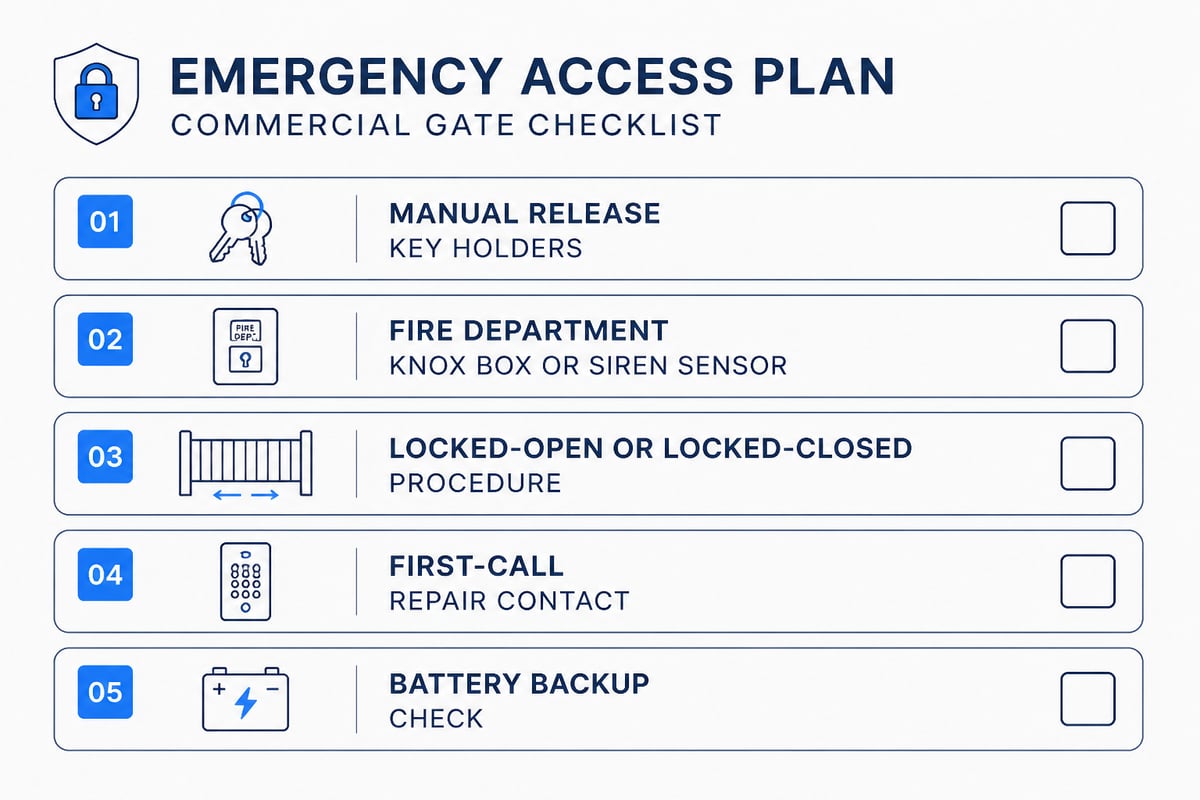
A written emergency access plan prevents a stuck gate from becoming a blocked fire lane, a halted delivery schedule or a security gap. This planning step is one of the most practical ways to reduce the downside of any gate system, and many buyers settle the details only after the first failure.
A workable plan answers five questions before the gate is ever installed:
- Who holds the manual release key or code, and is there a backup person on every shift?
- How do fire and police gain entry, through a Knox box, a siren sensor or a keyed override?
- What happens to vehicle flow when the gate is locked open or locked closed?
- Who is the first call for a malfunction, and what is the expected response time?
- Where is the battery backup, and who checks it?
Post the plan near the gate controller and review it each year. Insurance carriers often ask about emergency access during property reviews, and a documented plan answers that question quickly.
How Often Do Commercial Automatic Gates Need Maintenance?
Commercial automatic gates benefit from regular servicing, and more frequent visits make sense for high-traffic sites. A gate that cycles hundreds of times daily wears components far faster than a lightly used entrance.
A routine visit covers:
- Lubricating rollers, hinges, chains and tracks
- Testing photo eyes, edge sensors and loop detectors
- Checking force and reversal settings against UL 325 limits
- Inspecting wiring, the control board and battery backup
- Tightening hardware and checking gate alignment
- Verifying the manual release works
Keep a simple log of each visit and each fault. Patterns show up quickly: a gate that trips its sensors every Monday may have a debris or alignment problem, and a battery that fails each summer may need replacement before the next heat wave. Owners who want a problem diagnosed before scheduling a visit can review how to fix an automatic gate in Los Angeles to separate simple resets from faults that need a technician.
When Does Repair Make More Sense Than Replacement?
Repair makes more sense when the gate frame and structure are sound and the failure is limited to a motor, board, sensor or access device. Replacement becomes the better choice when the operator is obsolete, parts are no longer made, or repair costs approach the price of a new system.
Use this rule of thumb:
- Repair when the fault is a single component, the gate is under roughly 12 to 15 years old, and parts are available.
- Replace the operator only when the gate leaf is sturdy but the motor is worn out or underpowered for current traffic.
- Replace the full system when the frame is bent or rusted, the operator is discontinued, or the gate no longer meets current UL 325 and code requirements.
Request a written repair estimate and a replacement estimate side by side before you decide. A reputable provider will show both figures and explain the reasoning, rather than pushing the larger job. For failed motors, an expert automatic gate motor repair often restores a unit that looked ready for the scrapyard.
Who Repairs Commercial Automatic Gates in Los Angeles County?
Choose a licensed, insured technician who stocks parts on the truck and can respond the same day, because a stuck commercial gate costs money by the hour. Gates On Site is a family-owned Los Angeles company, and it staffs licensed technicians who handle gate repairs across the area.
For businesses with a failed operator, board or sensor, electric gate repair from Gates On Site covers same-day diagnosis and repair across Los Angeles County, with emergency service available throughout the day at no extra charge. The company holds over 100 five-star reviews on Google.
Local coverage matters for commercial sites, since a technician who already works your area arrives sooner. Gates On Site serves business districts from the San Fernando Valley to the South Bay, including commercial gate repair in Los Angeles and nearby cities such as Glendale, Burbank and Van Nuys.
Gates On Site focuses on repair and service rather than new-build installation, so it fits best when you already have a gate that needs attention.
FAQ
What is an autogate?
An autogate is a gate that opens and closes automatically using an electric operator and a control system. It responds to a remote, keypad, card reader, intercom or vehicle sensor, and it includes safety devices that stop or reverse the gate if something is in its path.
How long does a commercial automatic gate last?
A well-maintained commercial gate and operator commonly last 10 to 20 years, depending on traffic, climate and service history. Coastal locations and high-cycle entrances wear out components sooner, while regular maintenance extends the life of both the operator and the gate structure.
Can a commercial gate keep working during a power outage?
Yes, if it has battery backup or a manual release. A backup battery lets the gate cycle for a limited number of operations, and a manual release lets staff open the gate by hand when power and battery are both gone.
Start by listing the gate model, its age and the symptoms you have seen, then take a photo of the operator and control board so a technician can prepare the right parts. If your commercial gate is down or acting up, Gates On Site can diagnose and repair it across Los Angeles County, so call (323) 991-9630 to book a same-day visit.