
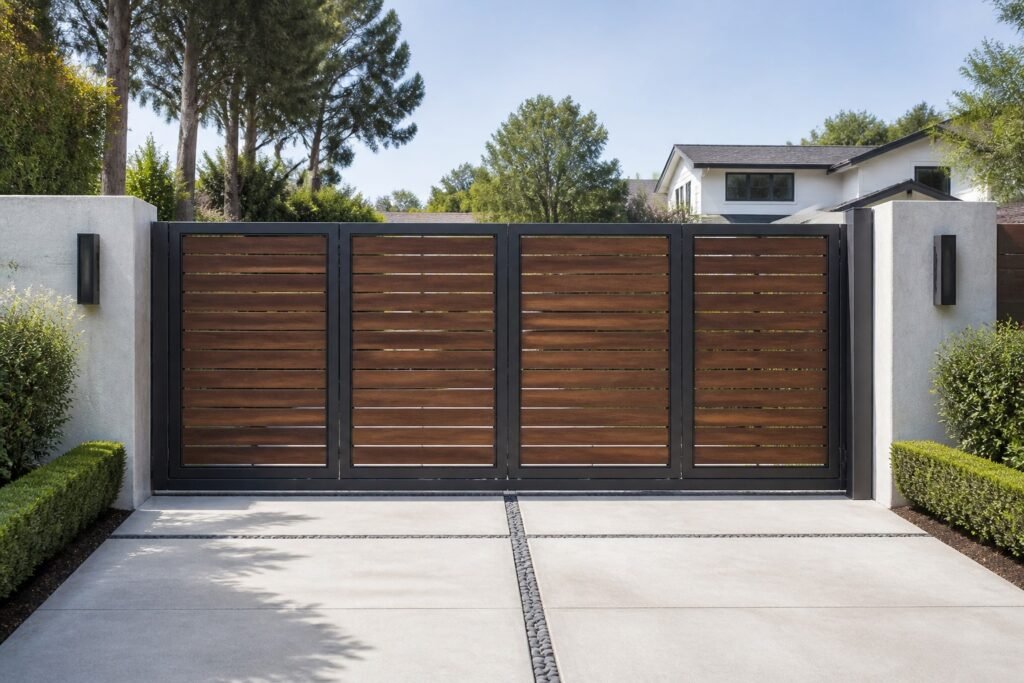
Driveway gate images show the main styles available (swing, slide, cantilever and bifold), the materials they are built from, and how each design looks against different home architectures. This guide organizes those images by style, material and operation so you can match a gate to your property, and it explains what each design means for long-term maintenance in Los Angeles County.
What Driveway Gate Images Reveal About Style
Looking at a set of gate photos tells you more than aesthetics: it shows proportion, privacy level, hardware placement and how the gate relates to the house behind it.
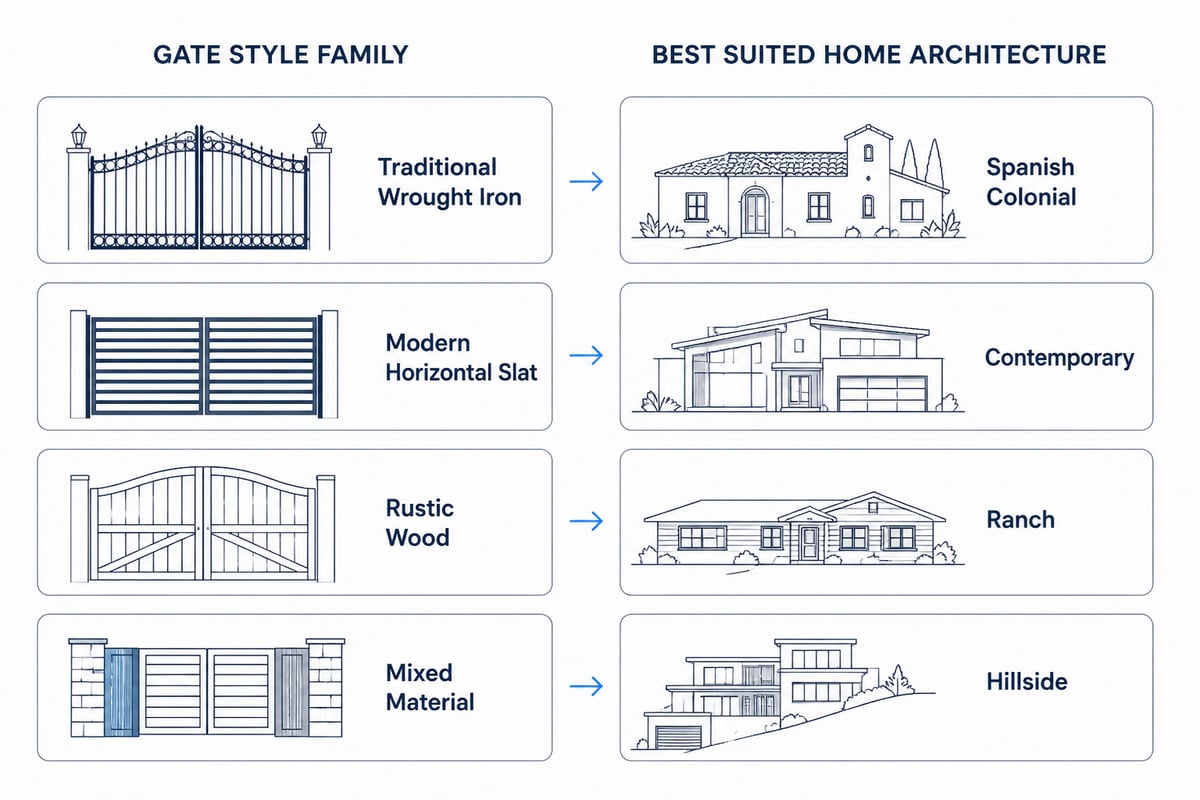
Most residential gates fall into a few visual families:
- Traditional wrought iron: scrolled tops, finials and vertical pickets that suit Spanish Colonial, Mediterranean and Tudor homes common across the San Fernando Valley.
- Modern horizontal slat: aluminum or wood slats with clean lines, often paired with stucco or concrete walls in mid-century and contemporary properties.
- Rustic wood: solid or framed boards, popular for ranch-style and hillside homes.
- Mixed material: a steel frame with wood or composite infill, which balances privacy with durability.
When you review photos, pay attention to the gap between pickets, the height relative to the wall or fence, and the visible hardware. Exposed hinges and operator arms are visible in many swing gate photos, while sliding gate photos usually show the track and the long return run along the fence line. Those details matter once the gate has to open and close thousands of times a year.
Swing, Slide, Cantilever and Bifold: Gate Types in Photos
The way a gate opens determines how much space it needs, and the photos make that visible at a glance.
Swing gates
Single or dual-leaf swing gates are the most common sight in residential photos. They need clear space for the leaves to arc inward or outward, so slopes, planters and parked cars near the entrance can limit them. Dual-leaf versions look balanced on wider openings and add a formal entrance feel.
Sliding gates
Sliding gates move parallel to the fence on a track or wheels. They suit steep driveways and tight street frontage because nothing swings into the drive. The tradeoff is the side run, which must stay clear of landscaping and structures.
Cantilever gates
A cantilever gate looks like a sliding gate without a ground track, because it is supported by rollers on posts and extends over the opening. This design works well where debris, gravel or uneven pavement would interfere with a track. One example guide from Elite LA Patios notes that a 12-foot driveway opening may require about 18 feet of clear side run for a cantilever gate, and it frames that as an example rather than a universal specification. Always confirm the dimensions for your own opening.
Bifold and vertical lift gates
Bifold gates fold in sections and take up less lateral space than a full slide. They appear in photos of narrow lots and commercial entries. Vertical lift and pivot gates are less common at homes but show up at commercial and industrial properties.
The standards body ASTM identifies F2200 as the standard specification for automated vehicular gate construction, covering horizontal slide and swing gates, vertical lift and pivot gates, overhead pivot gates and horizontal bifold gates. That list is a useful reminder that every style you see in a photo has a recognized construction category behind it.
Material Options and How They Hold Up
Material shapes both appearance and upkeep, and photos taken on installation day rarely show how a gate looks after several Southern California summers.
| Material | Typical look | Maintenance notes |
|---|---|---|
| Wrought iron or steel | Classic, ornate or minimal | Needs repainting and rust checks, especially at weld points and the base |
| Aluminum | Light, modern, many finishes | Resists rust, lighter on operators and hinges |
| Wood | Warm, private, rustic | Sun exposure causes warping and fading, needs sealing |
| Composite or mixed | Wood look with steel structure | Moderate upkeep, frame still needs inspection |
Weight is the factor photos hide. A heavy ornamental gate puts constant strain on hinges, rollers and the motor. A lighter aluminum gate reduces wear, which is one reason many property owners choose aluminum when they replace an aging unit. If you want to see how metal designs are typically specified, the metal driveway gate page is a practical starting point.
Matching a Gate to Your Driveway Layout
A gate that looks right in a photo can fail on your property if the layout does not support it, so measure and observe before choosing a style.
Redfin recommends considering the home's style, opening width, nearby trees and garden beds, traffic patterns, curbs, power lines and underground utilities when planning a driveway gate. Each of those items has a direct consequence:
- Slope: a driveway that rises toward the house often favors sliding or cantilever designs over swing gates.
- Setback: the distance from the street determines whether a swing gate can open without blocking the sidewalk or a waiting vehicle.
- Vegetation: overgrown shrubs and tree roots interfere with tracks, sensors and swing arcs.
- Utilities: buried lines and overhead wires limit where posts, footings and operators can go.
- Traffic: deliveries, rideshare drop-offs and multiple drivers favor faster operation and reliable safety sensors.
Walk the entrance and note each of these before you collect reference photos. It keeps your inspiration board grounded in designs that can physically work.
Driveway Gate Images by Operation: Manual vs. Automatic
Photos of an automatic gate look similar to photos of a manual one, but the equipment behind the gate decides how reliable it is day to day.
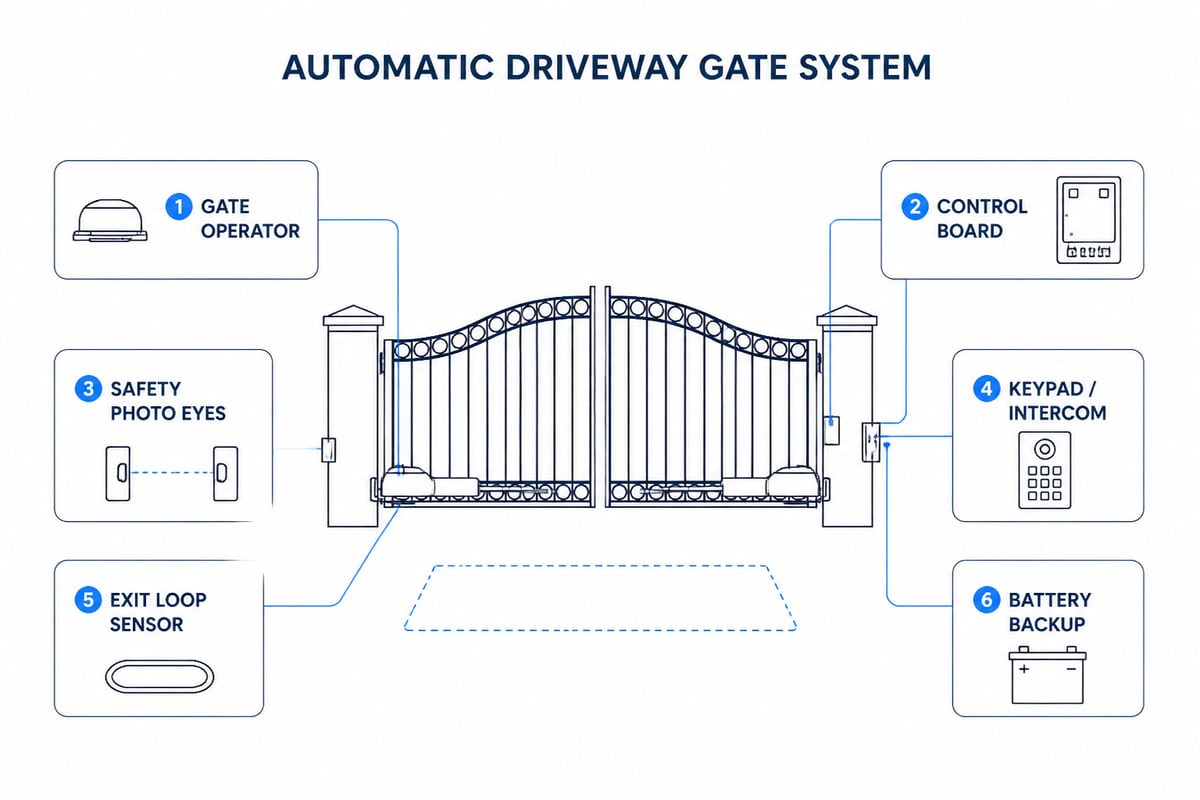
Most residential gates in Los Angeles County are automated, and the visible clues in a photo are the operator arm or chain drive, the keypad or intercom post, safety photo eyes and an exit loop or sensor in the pavement. Sliding gates typically use a rack-and-pinion or chain drive. Swing gates use linear actuators or underground operators.
If you are comparing automation options, the pages on motorized driveway gates and automatic gate openers for driveways explain the components you are likely to see in a finished installation.
Design Details That Photos Rarely Show
A handful of design decisions affect daily use far more than the decorative top rail, and they are worth checking in any gallery.
- Picket spacing and child or pet safety: wider gaps look open but let small animals through.
- Solid versus open infill: solid panels add privacy and also catch wind, which loads the operator.
- Hinge and roller quality: these wear first and are the most common cause of sagging and misalignment.
- Access points: a pedestrian gate beside the vehicle gate saves the main gate from unnecessary cycles.
- Backup power: a battery backup keeps the gate usable during outages and is easy to overlook until the first blackout.
- Manual release: the lever or key that lets you open the gate by hand should be reachable and clearly placed.
Ask whether any gate you admire in a photo includes these features, because they determine how it behaves in year five, not on day one.
Common Problems Behind a Beautiful Gate
Even a handsome gate eventually develops faults, and recognizing them early keeps a minor repair from becoming a replacement.
The issues that show up most often on Los Angeles County properties include:
- A gate that stops partway, grinds or reverses, often from misaligned sensors or worn rollers
- A remote or keypad that no longer responds, usually a control board, battery or receiver problem
- A motor that hums but does not move, which can point to a failed capacitor, stripped gear or loose chain
- Sagging swing leaves that drag on the pavement because hinges or posts have shifted
- Rust at the base of steel gates where moisture sits
Sun, irrigation overspray and heavy daily use accelerate most of these. If a gate in your own photo library of the property looks fine but behaves erratically, the fault is usually mechanical or electrical rather than cosmetic.
When an automated gate stops working, a licensed technician can diagnose it on the spot. Gates On Site handles electric gate repair across Los Angeles, and its licensed technicians can diagnose most faults on the spot.
Choosing Between Simple and Custom Designs
The choice between a simple gate and a custom one comes down to budget, architecture and how much upkeep you want to take on.
Simple designs, such as flat-top tubular steel or aluminum panels, use standard components, which generally makes replacement parts easier to source and repairs faster. You can browse examples of simple driveway gates to see how much style is possible without custom fabrication.
Custom designs allow unusual shapes, laser-cut patterns, mixed materials and house-matched details. The custom driveway gates page shows what that level of design looks like. Custom work usually brings more unique components, so it is wise to ask about parts availability and service access before you commit. For anyone budgeting, the page on driveway gate installation cost outlines the factors that move the price.
How to Use Gate Photos When Talking to a Professional
Bringing organized reference images to a consultation saves time and prevents misunderstandings about style and function.
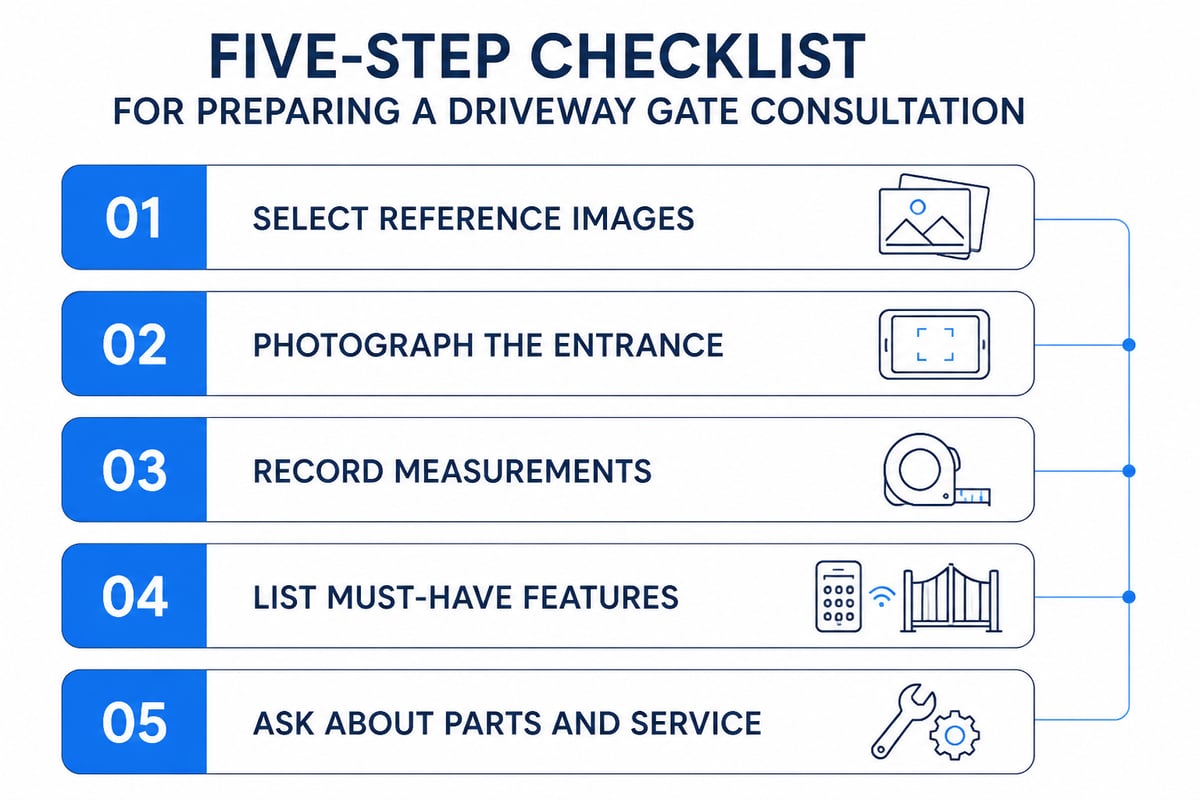
- Collect five to ten images that share a clear direction, rather than dozens that conflict.
- Photograph your own entrance from the street, from inside the property and along the fence line.
- Note measurements: opening width, slope, the distance to the nearest wall, tree or utility box.
- Mark must-have features such as privacy, a pedestrian door, solid panels or an intercom.
- Ask what will require ongoing service, including the operator type and the availability of parts.
These steps let a technician or fabricator tell you quickly whether a design is realistic for your site and which operator suits it.
Frequently Asked Questions
What is the most popular driveway gate style in Los Angeles?
Sliding and dual-swing gates are the most common, with aluminum and steel frames leading because they handle sun and heavy daily use well. The right choice still depends on your slope, setback and the look of the house.
Do driveway gate images show how much a gate will cost?
No. Photos show style, not price. Cost depends on size, material, operator type, site preparation and any custom fabrication, so request a quote based on your own opening.
Can I copy a gate from a photo?
In most cases a fabricator can reproduce the look, but the structure, weight and operator must be sized for your opening. A design that works on a flat, wide entrance may need changes on a sloped or narrow one.
How often should an automatic gate be serviced?
Regular inspection of rollers, hinges, sensors and the operator helps prevent breakdowns, and annual checks are a common recommendation. Gates with heavy traffic or exposure to irrigation and dust may benefit from more frequent attention.
What should I do if my automatic gate stops working?
Check for obstructions, confirm the gate has power, and try the manual release to rule out a jam. If it still fails, stop forcing the gate and call a technician, since repeated attempts can damage the motor or drive.
Start by photographing your current entrance from the street and along the fence line, then note any gate behavior that has changed recently, such as slow travel, grinding or a remote that no longer responds. If your gate is already installed and has stopped working, a licensed technician can diagnose it quickly. Gates On Site provides electric gate repair in Los Angeles, CA, offers emergency services at no extra charge, and has earned over 100 five-star reviews on Google. Contact Gates On Site to schedule a visit.