
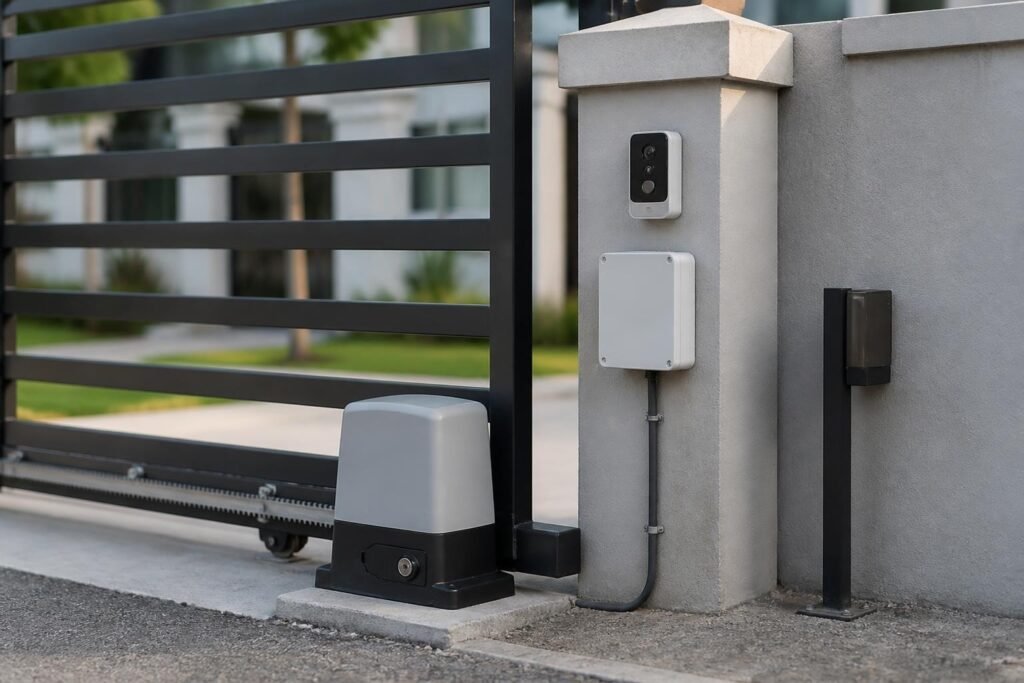
Finding reliable automatic gate services in your local area requires understanding what makes a quality installation and maintenance provider. Whether you're securing a residential driveway or managing a commercial facility, the search for "automatic gates near me" connects you with professionals who can design, install, and maintain systems that protect your property while providing convenient access. This guide explores everything you need to know about automatic gate systems, from selecting the right operator to ensuring compliance with safety standards, helping you make informed decisions when evaluating local service providers.
Understanding Automatic Gate Systems and Components
Automatic gates combine mechanical hardware, electrical operators, and control systems to provide secure, convenient access to properties. Modern systems range from simple single-swing residential gates to complex multi-panel commercial installations with advanced access control integration.
Core Components of Automatic Gate Operators
Every automatic gate system consists of several essential elements working together. The gate operator (motor) provides the power to move the gate, while the control board processes signals from access devices and safety sensors. Safety features include photo-eye sensors, edge sensors, and emergency release mechanisms that prevent entrapment and comply with UL 325 safety standards.
Key components include:
- Gate operators: Hydraulic, electromechanical, or solar-powered motors
- Control boards: Programmable logic controllers managing gate functions
- Access control devices: Keypads, card readers, smartphone apps, or intercoms
- Safety sensors: Obstruction detection and anti-entrapment systems
- Backup power: Battery systems ensuring operation during outages
The physical gate construction must meet ASTM F2200 standards, which specify requirements for materials, design loads, and structural integrity. Professional installers understand these requirements and ensure compliance during installation.
Types of Automatic Gate Configurations
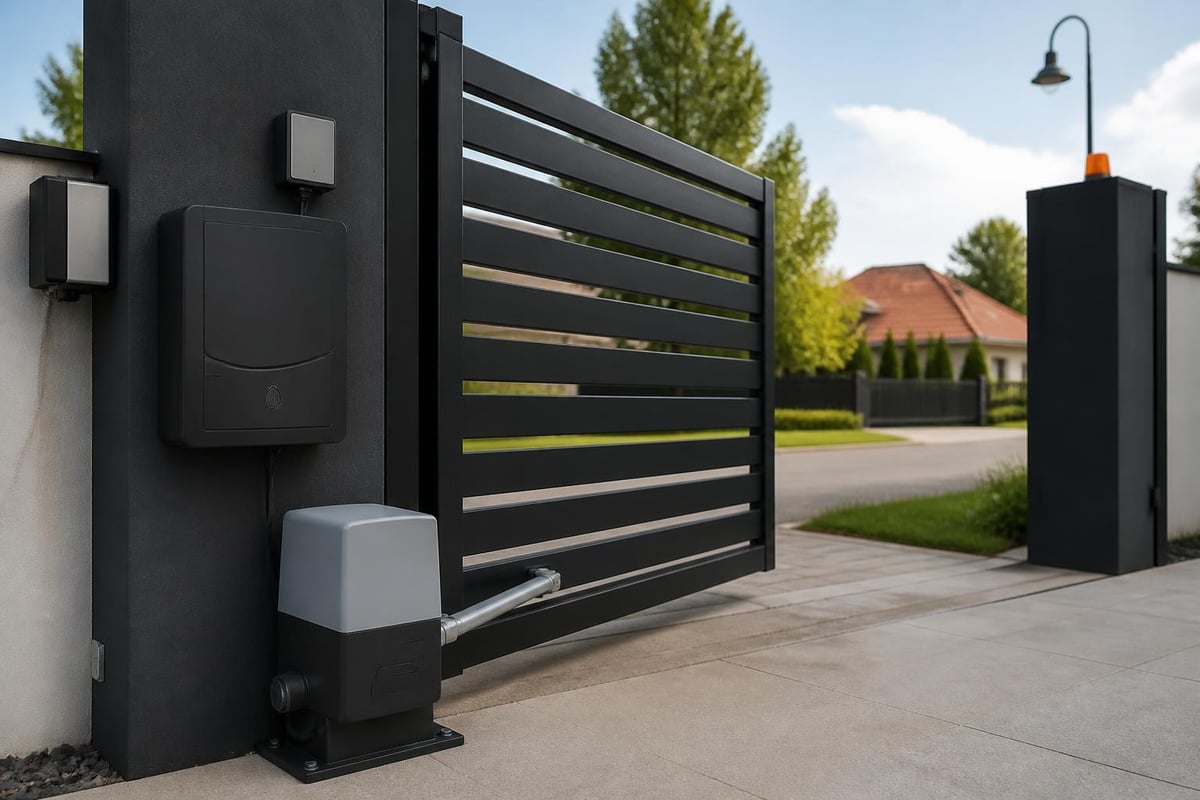
Swing gates operate on hinges, requiring clearance space to open inward or outward. These work well for residential driveways and smaller commercial applications where space permits the arc of movement.
| Gate Type | Space Required | Typical Use | Speed | Cost Range |
|---|---|---|---|---|
| Single Swing | Large arc clearance | Residential driveways | Moderate | $2,500-$5,000 |
| Dual Swing | Symmetrical clearance | Estate entries | Moderate | $4,000-$8,000 |
| Sliding/Cantilever | Parallel track space | Commercial facilities | Fast | $5,000-$12,000 |
| Vertical Lift | Overhead clearance | Parking structures | Very fast | $8,000-$20,000 |
Sliding gates move horizontally along a track, making them ideal for properties with limited driveway depth. Cantilever sliding gates eliminate ground tracks, reducing maintenance and improving reliability in areas with debris or weather challenges. When searching for automatic gates near me, understanding which configuration suits your property helps narrow down qualified installers.
Evaluating Local Automatic Gate Service Providers
When searching for automatic gates near me, the quality of your service provider directly impacts system performance, safety, and longevity. Los Angeles property owners should evaluate several critical factors before selecting an installer or repair technician.
Credentials and Industry Certifications
Professional gate technicians should demonstrate relevant training and certification. The American Fence Association offers specialized gate automation credentials that indicate comprehensive knowledge of installation practices, safety requirements, and troubleshooting procedures.
Essential qualifications include:
- State contractor licensing with appropriate classifications
- Manufacturer-specific training for major operator brands
- Insurance coverage including general liability and workers compensation
- Familiarity with local building codes and permit requirements
- Experience with both residential and commercial applications
Verify these credentials before allowing work to proceed. Experienced providers maintain documentation readily available for customer review.
Response Time and Service Area Coverage
Emergency gate failures require prompt attention, especially for commercial properties where access disruption affects business operations. Quality local providers offer same-day service for urgent repairs and clearly define their service territory.
Gates On Site provides same-day electric gate repair throughout Los Angeles and surrounding areas, arriving with fully stocked service vehicles to complete most repairs on the first visit. This approach minimizes downtime and eliminates the frustration of multiple service calls.
Consider service providers who:
- Answer calls promptly during business hours with knowledgeable staff
- Provide accurate time windows for service appointments
- Stock common replacement parts on service vehicles
- Offer emergency service without excessive premium charges
- Communicate clearly about diagnostic findings and repair options
Warranty Coverage and Service Agreements
Comprehensive warranty protection demonstrates provider confidence in their work quality. Review warranty terms covering both parts and labor, noting duration and exclusions.
Preventive maintenance agreements extend system life and reduce emergency repairs. Regular service visits include lubrication, adjustment, safety testing, and component inspection before failures occur. Annual maintenance typically costs $200-$400 but prevents repairs averaging $500-$1,500.
Safety Standards and Compliance Requirements
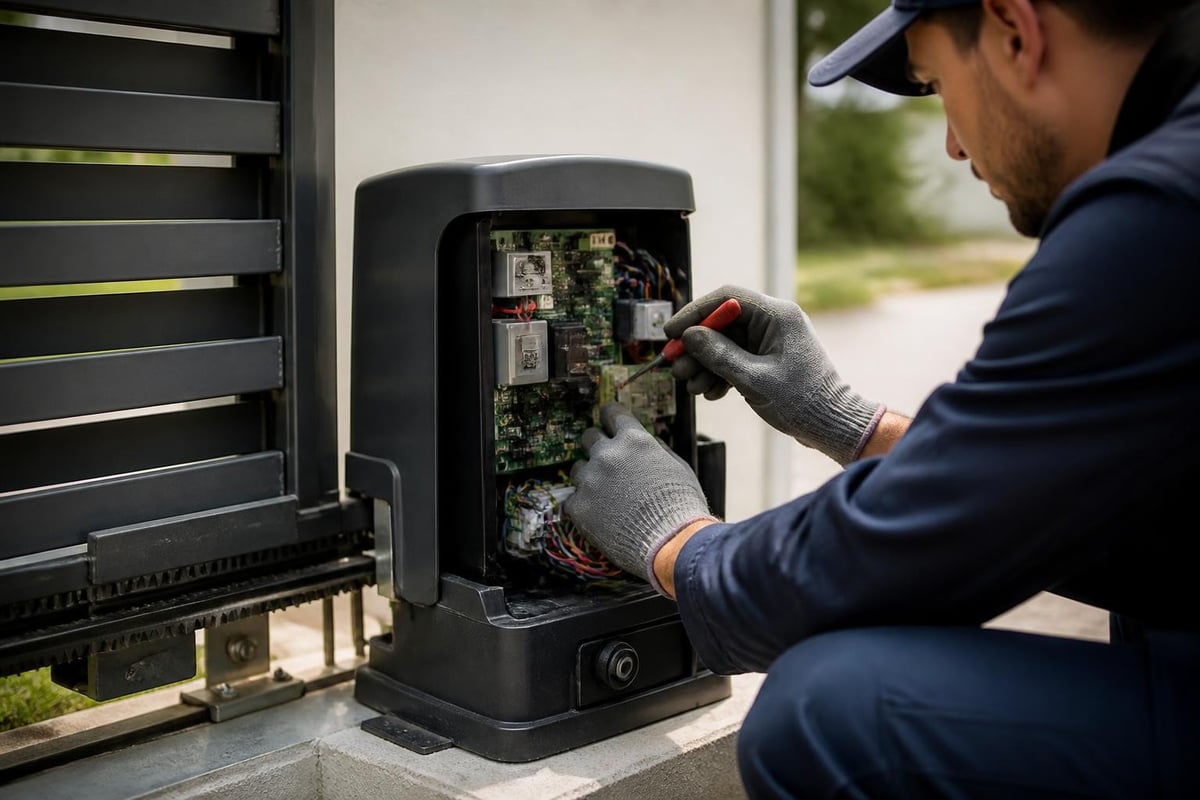
Automatic gate safety has evolved significantly following tragic entrapment incidents. Modern installations must incorporate multiple safety features and comply with stringent standards protecting users from injury.
Entrapment Protection Systems
Gates can exert significant force capable of causing serious injury or death. DASMA technical guidelines detail required safety features including monitored entrapment protection devices that reverse gate direction upon obstruction detection.
Required safety mechanisms:
- Photo-eye sensors across the gate travel path
- Pressure-sensitive edge sensors on contact surfaces
- Secondary entrapment protection devices independent of primary sensors
- Audible warnings during gate movement in commercial applications
- Manual release mechanisms accessible from both sides
- Emergency stop buttons at visible, accessible locations
These systems must be tested regularly and maintained in proper working condition. Property owners bear liability for injuries resulting from malfunctioning safety features, making professional maintenance essential.
Accessibility and ADA Compliance
Properties open to the public must ensure gate systems accommodate individuals with disabilities. The ADA design standards specify requirements for automatic door and gate operation, including activation methods, opening time, and clear width.
Commercial properties should work with installers familiar with ADA requirements to avoid costly remediation. Pedestrian gates adjacent to vehicle gates require particular attention to ensure compliant operation.
Smart Technology Integration and Cybersecurity
Modern automatic gates increasingly incorporate internet connectivity, smartphone control, and integration with home automation systems. While these features enhance convenience, they introduce cybersecurity considerations that require attention.
Connected Gate Control Systems
Smart gate operators allow remote monitoring and control through mobile applications. Homeowners can grant temporary access to visitors, receive notifications of gate activity, and integrate gates with security camera systems.
When evaluating automatic gates near me with smart capabilities, consider:
- Cloud-based vs. local control: Cloud systems require internet connectivity but enable remote access from anywhere
- Integration compatibility: Ability to work with existing home automation platforms
- User management: Granular control over access permissions and scheduling
- Activity logging: Detailed records of gate operations and access attempts
- Video integration: Coordination with intercom and camera systems
Securing Internet-Connected Gate Systems
Connected devices present potential security vulnerabilities that could allow unauthorized access or system disruption. The NIST guidance on IoT device security provides framework for evaluating manufacturer security practices.
Follow FTC recommendations for securing connected devices by implementing these protections:
- Change default passwords immediately upon installation
- Enable automatic firmware updates to patch security vulnerabilities
- Use strong, unique passwords for gate control applications
- Segment network traffic separating gate systems from critical devices
- Review access logs regularly for unusual activity patterns
Professional installers should configure systems with security best practices rather than leaving settings at manufacturer defaults. When searching for automatic gates near me, prioritize providers who understand cybersecurity implications.
Cost Factors and Budget Considerations
Automatic gate system costs vary widely based on gate type, operator selection, access control features, and installation complexity. Understanding cost components helps property owners budget appropriately and evaluate provider quotes.
Initial Installation Investment
Complete automatic gate installations typically range from $3,000 to $15,000 for residential applications and $8,000 to $40,000 for commercial projects. Several factors influence final costs:
| Cost Factor | Budget Impact | Considerations |
|---|---|---|
| Gate construction | $1,500-$8,000 | Material (wood, iron, aluminum), size, custom design |
| Operator system | $800-$4,000 | Residential vs. commercial duty, solar vs. electric |
| Access control | $200-$3,000 | Basic keypad to multi-user card/app systems |
| Installation labor | $1,000-$5,000 | Site preparation, electrical work, permit fees |
| Safety features | $300-$1,200 | Multiple sensors, monitored systems |
Properties requiring significant electrical work, concrete foundation preparation, or custom gate fabrication increase costs substantially. Obtain detailed written quotes from multiple providers when searching for automatic gates near me to compare pricing transparency.
Ongoing Maintenance and Repair Expenses
Annual operating costs include electricity (typically $30-$100 yearly), preventive maintenance ($200-$400), and occasional repairs. Commercial systems experience higher duty cycles requiring more frequent service.
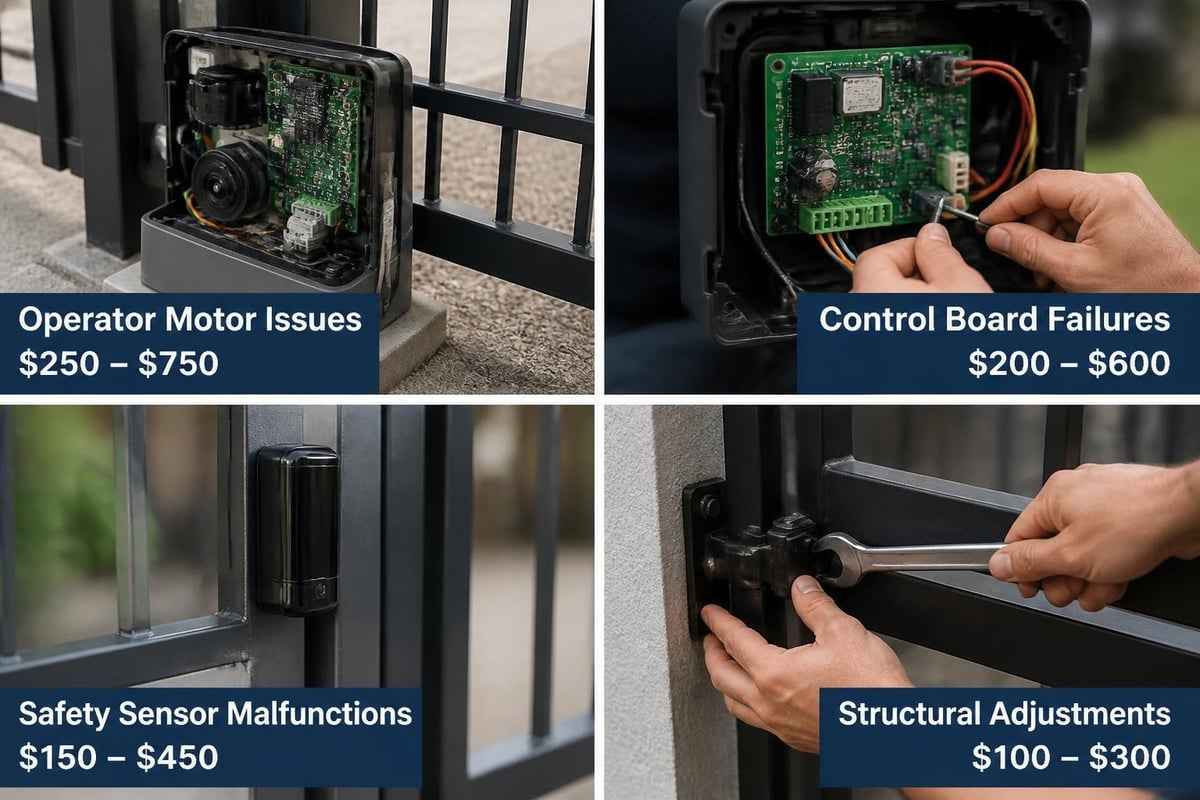
Common repair costs in Los Angeles:
- Operator motor replacement: $600-$1,500
- Control board repair/replacement: $300-$800
- Safety sensor replacement: $150-$400
- Remote control programming: $75-$150
- Gate realignment and adjustment: $200-$500
Choosing quality components during initial installation reduces long-term repair frequency. The gate repair services from Gates On Site address both routine maintenance needs and emergency failures throughout the Los Angeles area.
Selecting the Right Gate Operator for Your Application
Gate operator selection determines system reliability, performance, and maintenance requirements. Matching operator specifications to your gate weight, usage frequency, and environmental conditions ensures optimal operation.
Hydraulic vs. Electromechanical Operators
Hydraulic operators use fluid-filled cylinders to generate pushing or pulling force. These excel in heavy-duty commercial applications but require periodic fluid maintenance and perform poorly in extreme cold.
Electromechanical operators use geared motors providing reliable operation across broader temperature ranges. Modern brushless DC motors offer quiet operation and energy efficiency suitable for residential applications.
Operator comparison:
- Hydraulic advantages: Extreme force capability, smooth operation, handles very heavy gates
- Hydraulic disadvantages: Temperature sensitivity, fluid maintenance, higher cost
- Electromechanical advantages: Lower maintenance, cold weather performance, cost-effective
- Electromechanical disadvantages: Limited duty cycle on budget models, noise on older units
Commercial properties with gates exceeding 1,000 pounds typically benefit from hydraulic operators, while most residential applications perform well with quality electromechanical units.
Duty Cycle and Usage Ratings
Operator duty cycle indicates how frequently the gate can operate without overheating or premature wear. Residential operators typically handle 15-30 cycles daily, while commercial operators support 100+ cycles.
Understanding actual usage patterns prevents premature failures. A gated community entrance or commercial facility requires commercial-rated operators despite gate size, as high cycle counts exceed residential operator capabilities. When evaluating automatic gates near me, discuss actual usage requirements rather than assuming gate size alone determines operator needs.
Installation Process and Timeline Expectations
Professional automatic gate installation follows a structured process ensuring proper operation and safety compliance. Understanding typical timelines helps property owners plan accordingly.
Pre-Installation Site Assessment
Qualified installers conduct thorough site evaluation before providing final quotes. This assessment examines:
- Gate opening dimensions and required clearances
- Ground conditions for posts, tracks, or pad mounting
- Electrical service availability and required upgrades
- Drainage patterns affecting track or sensor placement
- Line-of-sight requirements for wireless devices
- Underground utility locations preventing excavation conflicts
This evaluation often reveals issues affecting installation approach or cost. Transparent providers communicate these findings clearly rather than discovering problems mid-project.
Typical Installation Timeline
Standard residential automatic gate installations typically complete within 2-5 days from project start. Complex projects requiring extensive electrical work, custom gate fabrication, or challenging site conditions may extend to 2-3 weeks.
Installation phase breakdown:
- Site preparation and excavation: 1-2 days
- Post or track installation and concrete work: 1-2 days (plus curing time)
- Electrical service installation: 1 day
- Gate and operator mounting: 1 day
- Control system programming and testing: 0.5-1 day
- Safety system verification and adjustment: 0.5 day
Permit acquisition adds 1-4 weeks depending on local building department processing times. Professional installers manage permit applications and schedule inspections appropriately. The automatic gate repair specialists at Gates On Site also handle installation projects requiring expert knowledge of Los Angeles building requirements.
Troubleshooting Common Automatic Gate Issues
Understanding common gate problems helps property owners communicate effectively with service providers and make informed repair decisions when searching for automatic gates near me.
Gate Movement Problems
Gates that fail to open or close completely often experience limit switch issues, obstruction detection activation, or mechanical binding. Operators may hum without gate movement, indicating motor or gearbox problems requiring professional attention.
Common movement issues:
- Gate opens partially then reverses: Safety sensor activation or obstruction
- Gate moves slowly or hesitates: Low battery voltage or worn motor
- Gate won't move at all: Power supply issues, burned motor, or control board failure
- Gate closes too hard: Impact force adjustment needed for safety compliance
- Unusual grinding or scraping sounds: Worn hinges, track debris, or misalignment
Attempting DIY repairs on automatic gate operators risks injury and may violate warranty terms. Professional diagnosis identifies root causes rather than treating symptoms.
Access Control and Remote Issues
Intermittent remote control operation typically results from weak batteries, radio interference, or receiver sensitivity problems. Multiple remotes failing simultaneously suggests receiver or control board issues rather than individual remote failures.
Modern radio frequency environments include numerous devices potentially interfering with gate receivers. Professional installers test systems under actual site conditions and select frequencies minimizing interference.
Safety Sensor False Triggers
Photo-eye sensors blocking gate operation without visible obstruction may suffer from:
- Misalignment between transmitter and receiver
- Lens contamination from dirt, spider webs, or moisture
- Sunlight interference on infrared sensors
- Damaged wiring or loose connections
- Component failure requiring replacement
Monthly cleaning and visual inspection prevents many false trigger issues. When problems persist, professional testing with specialized equipment identifies component failures requiring replacement.
Understanding automatic gate systems, safety requirements, and maintenance needs helps property owners make informed decisions when selecting local service providers. Whether installing a new gate system or maintaining an existing installation, working with experienced professionals ensures reliable operation and compliance with safety standards. When your automatic gate needs expert attention, Gates On Site delivers same-day repair and installation services throughout Los Angeles, combining over 20 years of experience with comprehensive parts inventory and emergency service at no extra charge.