
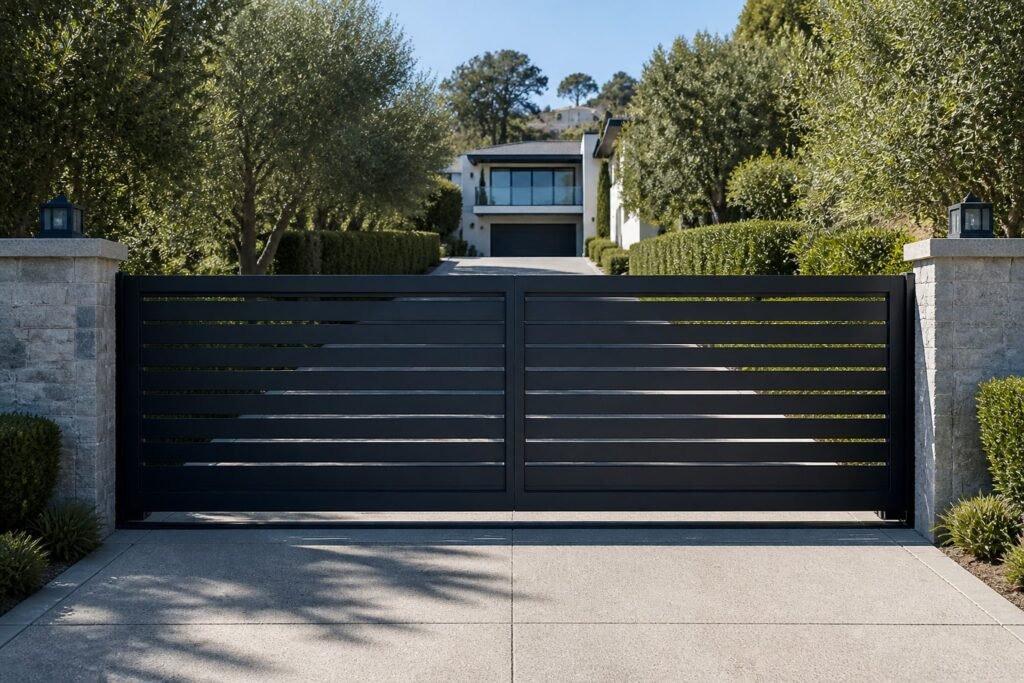
Custom automatic gates are made-to-fit driveway or property entrances that open and close with a motorized operator, and the right choice depends on your lot layout, gate style, material, safety standards and long-term maintenance. For Los Angeles homeowners, a good purchase balances design with the practical demands of steep driveways, coastal air, heat and local pool-safety rules.
This guide walks through the decisions that shape a custom gate, from swing versus slide to operator selection, code requirements and the ownership costs that follow installation.
What Makes a Gate "Custom" and Why It Matters in Los Angeles
A custom gate is designed around your property's dimensions, slope, architecture and security needs rather than chosen from a fixed catalog size. In Los Angeles, that distinction matters because lots vary widely: hillside driveways in the Hollywood Hills, narrow setbacks in Venice, long estate approaches in Encino and Calabasas.
A custom build typically involves four decisions made together:
- Gate style: swing, slide, bifold or overhead, based on available clearance and grade.
- Material: wrought iron, aluminum, steel, wood or a composite, based on climate exposure and appearance.
- Operator: the motor and control system sized to the gate's weight, width and usage.
- Access and safety: keypads, remotes, intercoms, smartphone control, sensors and safety edges.
Treating these as one design problem, rather than separate purchases, avoids the common mismatch of a beautiful gate paired with an underpowered motor. If you want a closer look at design options, Gates On Site has a page on custom driveway gates that shows the range of styles homeowners request.
Choosing Between Swing, Slide, Bifold and Overhead Gates
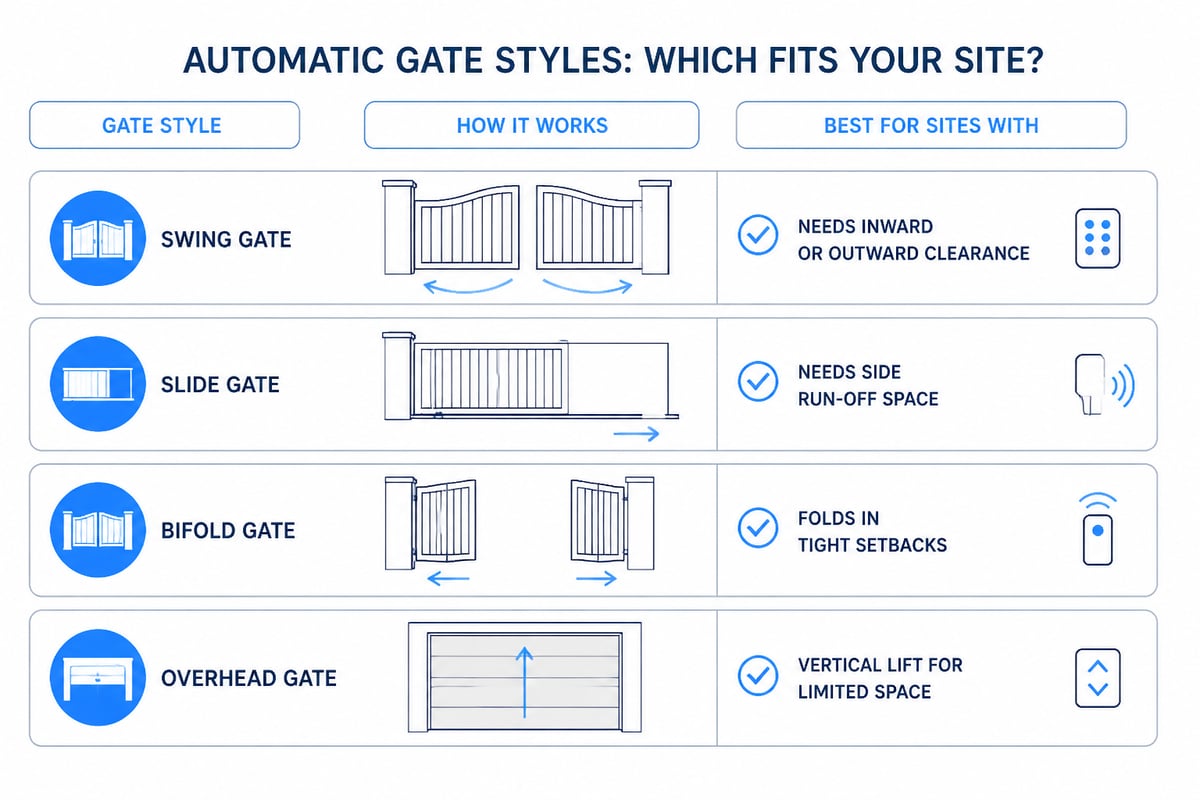
The best gate style is the one your driveway geometry can physically support, since slope, setback depth and side clearance eliminate options quickly.
| Gate style | Space it needs | Works well for | Watch out for |
|---|---|---|---|
| Swing | Clear arc in front of or behind the gate | Flat, level driveways with room to open | Slopes that make the leaf drag or strike the ground |
| Slide | A run of fence or wall beside the opening | Steep or uneven driveways, tight entries | Track debris, and the need for a long side run |
| Bifold | Less swing depth than a standard swing gate | Short setbacks near the street | Added hinges and moving parts to maintain |
| Overhead | Headroom above the opening | Very limited side and front clearance | Higher structural demands on posts or framing |
ASTM International's F2200-24 standard covers the construction of automated vehicular gates across these configurations, including horizontal slide, horizontal swing, vertical lift, vertical pivot, overhead pivot and horizontal bifold designs. Asking a designer which configuration their proposal follows is a reasonable first question.
Slope deserves special attention in Los Angeles. A swing gate on a grade needs either a gate that rises as it opens or a redesigned approach. A sliding gate often solves the problem outright, which is why it is common on hillside properties.
Materials: Matching the Gate to LA's Climate
Material choice affects appearance, weight, upkeep and how well the gate holds up to sun, salt air and temperature swings.
- Wrought iron: Classic and strong, but heavy. It needs periodic repainting and rust treatment, especially near the coast.
- Aluminum: Lighter, naturally corrosion resistant and easier on the operator. A strong choice for coastal neighborhoods and for owners who want low upkeep.
- Steel: Very durable and suited to solid privacy designs, though weight and rust protection must be planned for.
- Wood: Warm and architectural, but it expands, contracts and fades in intense sun. It demands regular sealing.
- Composite or hybrid panels: Useful when you want a wood look with less maintenance.
Weight is the detail that links material to mechanics. Every pound added to a gate increases the load on hinges, tracks and the motor. A heavy solid-panel gate paired with a light-duty operator will wear out quickly, and the failure often shows up as slow travel, grinding or a motor that overheats on hot afternoons.
Selecting the Operator, Controls and Access Technology
The operator is the part of a gate that most determines long-term reliability, so it should be sized to the gate's weight, length and daily cycle count rather than to the lowest price.
When specifying an operator, look at these factors:
- Duty rating. A gate used by a single household a few times a day has different needs than a shared driveway used constantly.
- Drive type. Hydraulic and electromechanical systems behave differently in heat and at slow speeds. Ask how each handles Los Angeles summer temperatures.
- Battery backup or solar assist. Power outages and brush-fire shutoffs are real concerns in Southern California, and a gate that cannot open during an outage becomes a barrier for you and for emergency vehicles.
- Manual release. A clearly accessible release lets you open the gate without power.
- Access methods. Remotes, keypads, intercom and video entry, and smartphone control can be combined. Gates On Site covers connected options on its page about smart gate systems in Los Angeles.
If you are comparing motors, the page on the best electric gate opener outlines what separates a dependable unit from one that will need early service.
Safety Standards Every Custom Gate Should Meet
An automatic vehicular gate should comply with UL 325, the safety standard for gate operators, and your gate should include entrapment protection such as sensors and contact edges. ASTM's F2200-24 states that automated vehicular gate systems must comply with UL 325.
It also distinguishes four use classes, which tell you what level of build suits your site:
- Class I: a single-family home or parking area.
- Class II: commercial locations or multifamily and public-serving properties.
- Class III: industrial locations.
- Class IV: guarded industrial locations.
A residential driveway typically falls under Class I, while an apartment building, medical office or retail property falls under Class II. Specifying the right class matters for property managers, since higher traffic and public exposure raise the stakes on safety features. UL's overview of access control and gate operators explains UL 325 listing and the entrapment-protection considerations behind it, and ASTM's discussion of gate-related hazards describes why protections such as positive stops and fall-over safeguards exist.
Photo eyes, reversing sensors and edge protection are not optional extras. They are the features that keep children, pets, cyclists and vehicles safe, and they should be confirmed in writing before you approve a design.
California Pool-Safety Rules That Can Affect Your Gate
If your property has a pool or spa, a gate that leads to it must follow California's pool-enclosure requirements, which differ from the rules for a driveway gate.
Under California Health and Safety Code §115923, access gates to a pool enclosure must open away from the pool and be self-closing and self-latching, with the latch at least 60 inches above ground. Separately, Health and Safety Code §115922 requires at least two of seven drowning-prevention features when a permit is issued for a new pool or spa, or for remodeling an existing one, at a private single-family home. That provision took effect January 1, 2025.
The practical takeaway for a custom project: if a side-yard gate or backyard entry doubles as a pool barrier, tell your designer at the start. A decorative gate that looks right but latches too low, or swings toward the water, can fail inspection and force a rebuild. Confirm requirements with your local building department, since cities across Los Angeles County may add their own conditions.
Permits, HOA Review and Planning Ahead
Most custom gate projects in Los Angeles involve at least one approval step, so plan for review time before you commit to a build schedule.
Common checkpoints include:
- Building and electrical permits, which often apply to new gates, posts and powered operators.
- Height and setback limits, which vary by city and zoning and may restrict how tall or how close to the street a gate can be.
- HOA or architectural review, where design, color and material may need approval.
- Utility locates, to avoid damaging buried lines when setting posts.
- Fire access, since some areas require emergency access methods such as a Knox box or approved override.
A written scope that names the gate class, the safety devices, the power source and the manual release gives you something concrete to compare across bids and to check against inspection requirements.
Ownership Costs and Maintenance After Installation
A custom gate is a mechanical system, and its lifespan depends as much on service as on the initial build. Hinges wear, rollers flatten, sensors drift out of alignment, and control boards fail, often on the hottest or rainiest day of the year.
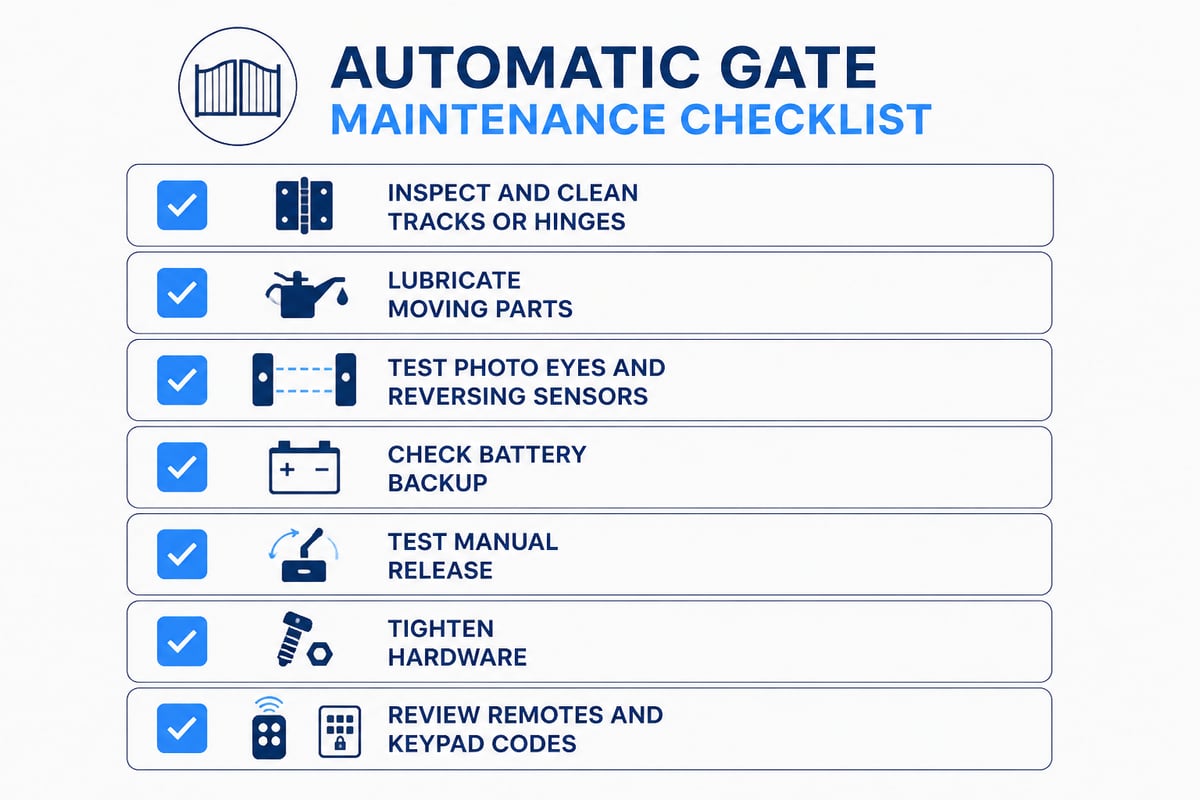
A simple routine keeps small issues from becoming emergency calls:
- Clear debris from tracks, hinges and the ground path each season.
- Lubricate moving parts as the manufacturer recommends.
- Test safety sensors and reversing behavior monthly.
- Check the battery backup and confirm the manual release still works.
- Schedule professional automatic gate servicing at least once a year.
Budget for these costs from the start. For a sense of what a gate project can involve, see Gates On Site's overview of the cost of a gate. Your final figure will depend on your design, materials and site conditions.
When a Gate Stops Working: Repair Before You Replace
When an automatic gate stops responding, the cause is often a repairable component such as a motor, board, sensor, remote or worn roller, not a failed gate. Replacing a whole system is rarely the first answer.
Typical symptoms and likely sources:
- Gate does not move, motor hums: capacitor, motor or a mechanical obstruction.
- Gate reverses or stops partway: misaligned or dirty safety sensors, or a force setting issue.
- Remote works intermittently: weak batteries, receiver problems or interference.
- Slow, noisy or jerky travel: worn rollers, dry hinges or a failing drive.
- Gate stuck after a power loss: battery failure or a manual release left disengaged.
For Los Angeles County homeowners and commercial property managers, Gates On Site handles this kind of work through its electric gate repair service. The company, a family-owned business, stocks its mobile service vehicles with parts and tools so many repairs can be completed on the first visit, and emergency service is available at no extra charge.
Questions to Ask Before You Approve a Design
Asking specific questions before you sign protects you from mismatched components and unclear warranties.
- Which ASTM F2200 use class is this gate designed for, and is the operator UL 325 compliant?
- What entrapment-protection devices are included, and where are they placed?
- How was the operator sized to the gate's weight and daily use?
- What happens during a power outage, and where is the manual release?
- If a pool or spa is involved, how does the gate meet California's self-closing and self-latching requirements?
- Who handles permits and HOA submissions?
- Who will service the gate after installation, and what is covered under warranty?
Clear answers to these questions are a good sign that a proposal is built for real conditions and not just for a rendering.
Your next step is to write down your driveway's slope, setback depth and daily usage, then use the checklist above to compare any design you are considering. If you already own a gate that has stopped working, or you want a technician to inspect an existing system before you plan an upgrade, Gates On Site offers electric gate repair across Los Angeles County. As a family-owned, licensed and insured team with a 100% satisfaction guarantee on every repair, they can diagnose the problem and tell you whether repair or replacement makes sense. Call (323) 991-9630 to speak with Gates On Site about your gate or garage door.