
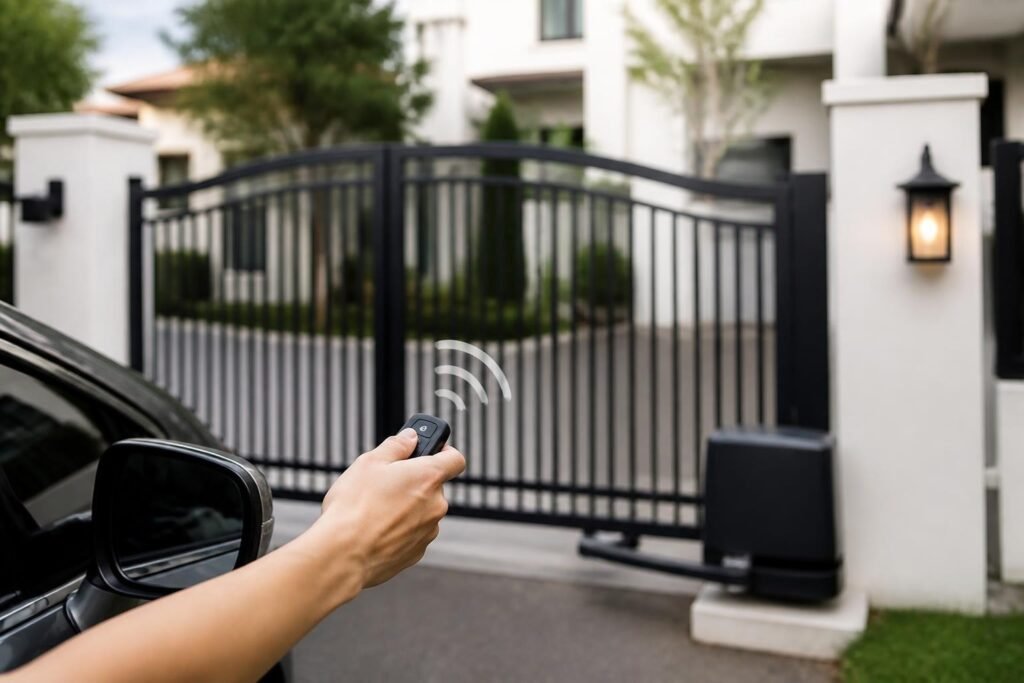
Remote control gates have transformed property access management for both residential and commercial applications. These automated systems combine convenience with enhanced security, allowing property owners to control entry without leaving their vehicles or buildings. Understanding the technology, safety requirements, and maintenance considerations helps ensure reliable operation and long-term value from your investment in automated access control.
Understanding Remote Control Gate Technology
Modern remote control gates operate through sophisticated electronic systems that coordinate multiple components. The gate operator (motor) receives encrypted signals from handheld transmitters, wall-mounted keypads, or smartphone applications. These signals trigger the motor to open or close the gate along its designated path, whether sliding horizontally or swinging inward or outward.
The communication between remote controls and gate operators relies on radio frequency (RF) technology, typically operating in the 300-400 MHz range. Current systems employ rolling code encryption, which generates a new access code with each use to prevent unauthorized duplication. This security feature has largely replaced older fixed-code systems that were vulnerable to code grabbing devices.
Components of a Remote Control Gate System
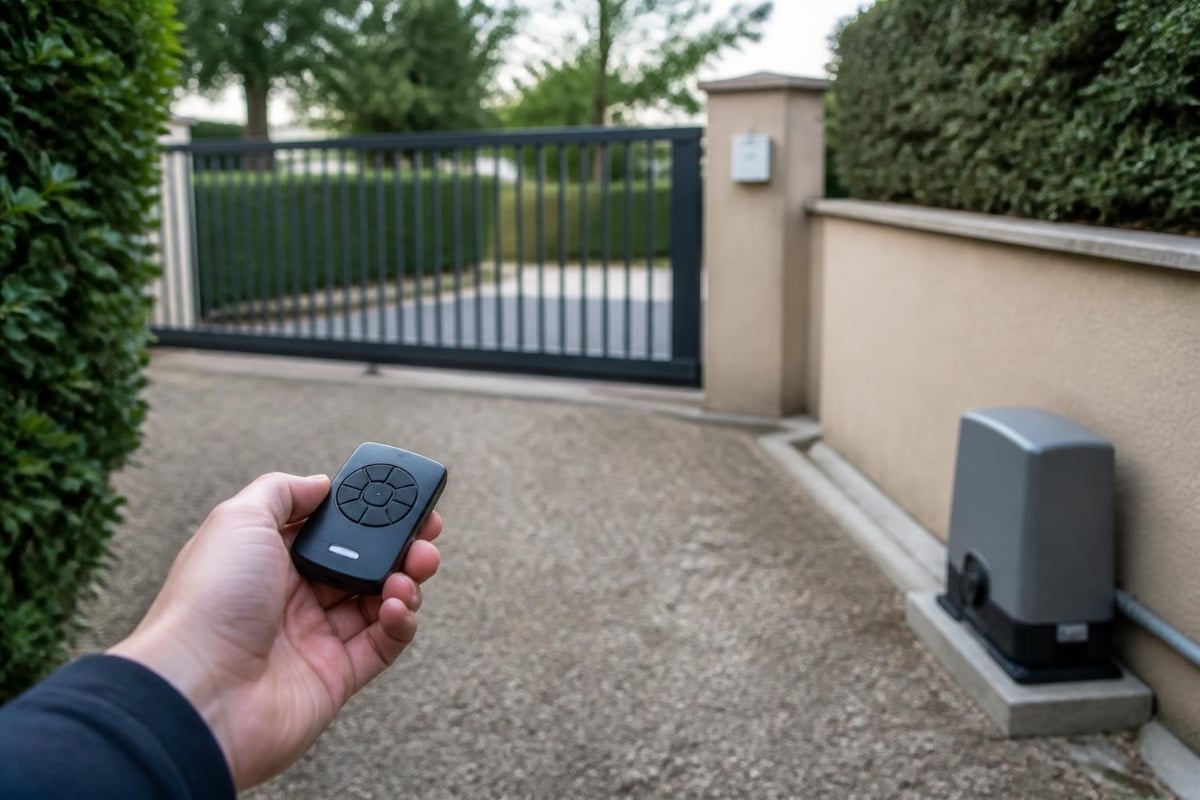
A complete remote control gate installation requires several integrated components working in harmony:
- Gate operator (motor): Provides the mechanical force to move the gate
- Control board: Processes signals and manages safety features
- Remote receivers: Decode transmitted signals from access devices
- Power supply: Typically 110V AC converted to low-voltage DC for motors
- Safety sensors: Photoelectric beams, edge sensors, and pressure-sensitive devices
- Backup battery system: Ensures operation during power outages
The control board serves as the system's brain, managing not only access commands but also safety protocols. Modern boards can store hundreds of individual remote codes, manage timed access schedules, and log entry events for security monitoring. Some advanced systems integrate with broader property management platforms, enabling centralized control of multiple access points.
Safety Standards and Regulatory Compliance
Safety represents the paramount consideration in remote control gate design and installation. The UL 325 safety standard for gate and door operators establishes comprehensive requirements for entrapment protection, ensuring gates detect and respond to obstructions. Federal regulations have incorporated these standards to protect users nationwide.
Entrapment Protection Requirements
Remote control gates must incorporate multiple safety mechanisms to prevent injury. Primary entrapment protection typically includes photoelectric sensors positioned across the gate's path of travel. When the invisible beam is interrupted, the system immediately stops and reverses the gate's movement. Secondary protection comes from edge sensors-pressure-sensitive devices mounted along the gate's leading edge that detect contact with objects or people.
The UK Health and Safety Executive provides detailed guidance on powered gate hazards and required safety measures. Their recommendations emphasize regular testing of safety devices, proper signage, and documentation of maintenance activities. Property owners and operators bear legal responsibility for ensuring gates remain safe throughout their service life.
| Safety Feature | Function | Testing Frequency |
|---|---|---|
| Photoelectric sensors | Detect obstruction in gate path | Monthly |
| Edge sensors | Detect physical contact | Monthly |
| Emergency stop button | Manual override for emergencies | Quarterly |
| Auto-reverse mechanism | Reverses on resistance | Monthly |
| Warning signs/lights | Alert users to gate movement | Annual inspection |
Commercial installations face additional scrutiny under federal unattended operation requirements, which mandate specific safety controls when gates operate without direct supervision. These regulations specify sensor placement, force limits, and emergency access provisions to protect both authorized users and the general public.
Types of Remote Control Gates
Remote control gates come in several configurations, each suited to different property layouts and security needs. Understanding the distinctions helps property owners select the appropriate system.
Sliding Gates
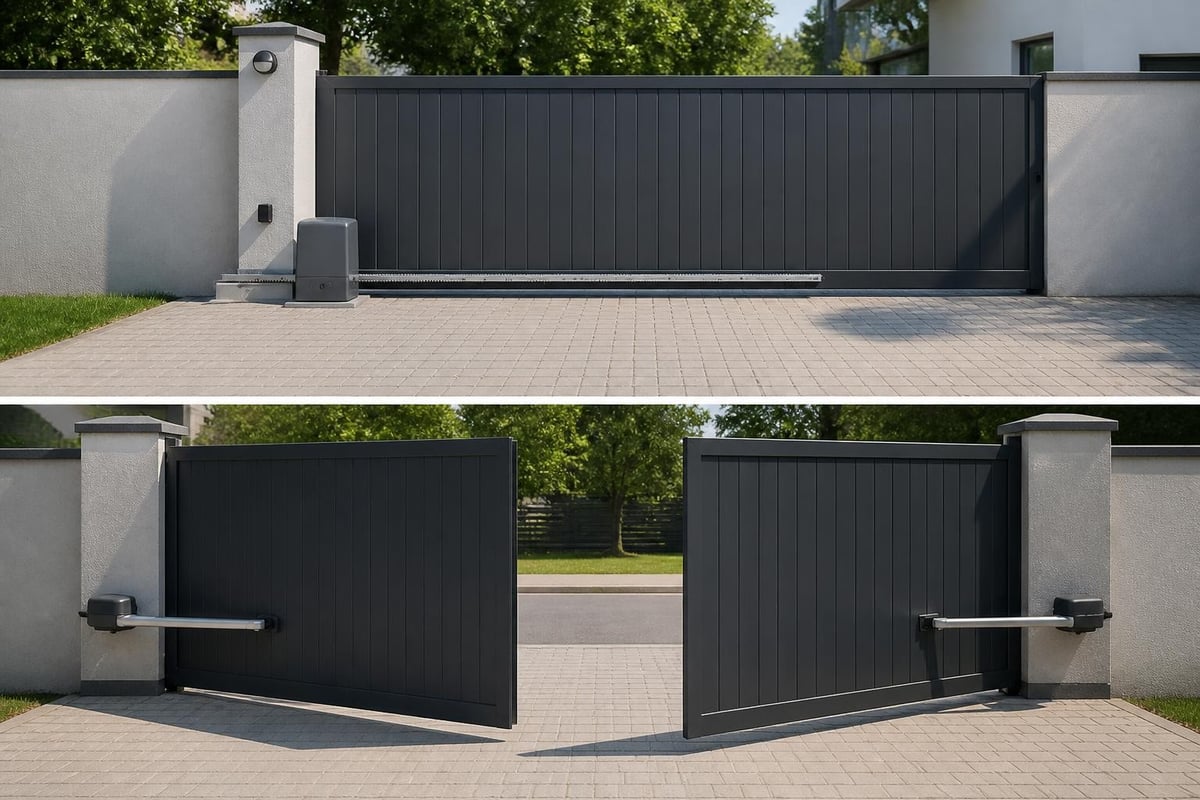
Sliding gates move horizontally along a track, requiring space parallel to the fence line rather than into the property. These systems excel in areas with sloped driveways or limited clearance. The gate typically rides on wheels guided by a track, with the motor positioned at one end driving the gate through a chain, rack-and-pinion, or direct-drive mechanism.
Cantilever sliding gates represent an advanced variation that eliminates the ground track, instead suspending the gate from rollers mounted on a support frame. This design prevents track blockage from debris, ice, or snow-particularly valuable in regions experiencing harsh weather conditions.
Swing Gates
Swing gates operate like traditional doors, pivoting on hinges to open inward or outward. Single-swing configurations use one large gate panel, while double-swing systems split the opening between two panels meeting in the center. Swing gates require adequate clearance in their arc of travel but avoid the parallel space requirements of sliding systems.
Underground operators offer an aesthetically pleasing option for swing gates, hiding the motor mechanism below grade. Surface-mounted operators provide easier access for maintenance while remaining visible on the gate post or adjacent pillar.
Vertical Lift and Barrier Gates
Vertical lift gates raise straight up, making them ideal for areas lacking horizontal clearance. These systems commonly appear in parking facilities and high-security commercial installations. Barrier arm gates use a lightweight pivoting arm for high-volume traffic control, balancing speed with basic access restriction rather than physical security.
Installation Considerations for Remote Control Gates
Proper installation ensures reliable operation and longevity. Professional assessment of site conditions, power requirements, and user needs prevents costly corrections after installation.
Site Preparation Requirements
Installation begins with evaluating the gate opening dimensions, ground conditions, and available space for equipment. Level, stable ground supports accurate gate alignment and smooth operation. Slopes exceeding three degrees require special consideration, potentially necessitating modifications to standard installation procedures or equipment selection.
Power availability dictates motor selection and may require electrical service upgrades. Most residential systems operate on standard 110V circuits, but commercial installations with heavy-duty cycles often benefit from dedicated circuits or higher voltage supplies. Solar-powered options provide solutions for remote locations lacking electrical infrastructure, though they require adequate sun exposure and larger battery banks.
- Measure the opening accurately, accounting for gate overlap and clearance requirements
- Verify ground conditions through soil testing for post installation stability
- Assess power availability and plan electrical runs to operator location
- Plan for safety sensor placement ensuring complete coverage of hazard zones
- Consider drainage to prevent water accumulation affecting gate movement
Professional Installation vs. DIY Approaches
While enthusiastic homeowners may consider self-installation to reduce costs, remote control gates involve electrical work, structural calculations, and safety system integration requiring specialized knowledge. Licensed electric gate repair technicians bring expertise in local code compliance, proper component sizing, and safety standard adherence that protects both property owners and users.
Professional installers carry liability insurance covering accidents during installation and resulting from improper work. They also provide warranties on both equipment and labor, offering recourse if problems emerge. The ASTM F2200 standard for automated vehicular gate construction outlines specific requirements that professional installers understand and implement consistently.
Maintenance and Troubleshooting
Regular maintenance extends remote control gate lifespan while ensuring continued safe operation. Establishing a routine inspection schedule prevents minor issues from becoming major failures.
Essential Maintenance Tasks
Monthly visual inspections catch developing problems before they cause breakdowns. Check for signs of wear on moving parts, verify safety sensor alignment using the gate's test mode, and clean debris from tracks or hinges. Lubricate pivot points, rollers, and chains according to manufacturer specifications-typically every three months in residential applications and monthly for high-traffic commercial installations.
Annual professional service should include:
- Complete safety system testing and certification
- Motor inspection and electrical connection verification
- Gate balance and alignment adjustment
- Photo sensor calibration and cleaning
- Control board settings review
- Backup battery load testing and replacement if needed
Keep detailed maintenance logs documenting all service activities, part replacements, and safety tests. This documentation demonstrates due diligence for liability purposes and helps technicians diagnose recurring issues by revealing patterns over time.
Common Problems and Solutions
Remote control gates may exhibit various symptoms indicating specific component failures or adjustments needs. Understanding these relationships helps property owners communicate effectively with repair technicians and assess repair urgency.
| Symptom | Likely Cause | Urgency |
|---|---|---|
| Gate won't respond to remote | Dead remote battery, receiver failure, or interference | Medium |
| Gate reverses without obstruction | Misaligned sensors, excessive force setting | High (safety issue) |
| Gate moves slowly | Low battery backup, worn motor, or mechanical binding | Medium |
| Intermittent operation | Loose electrical connections or failing control board | High |
| Gate doesn't close completely | Limit switch adjustment needed or mechanical obstruction | Medium |
Intermittent remote control response often stems from radio frequency interference rather than equipment failure. Other wireless devices, metal structures, or electrical equipment can disrupt signals. Repositioning the receiver antenna or upgrading to a higher-frequency system often resolves these issues.
Advanced Features and Smart Integration
Modern remote control gates increasingly incorporate smart technology, expanding capabilities beyond basic access control. These features enhance convenience, security, and integration with broader property management systems.
Smartphone Control and Monitoring
Mobile applications have largely replaced dedicated remote controls for many users. Smartphone apps communicate with gate systems through WiFi or cellular connections, enabling operation from anywhere with internet access. This capability allows property owners to grant temporary access to visitors, service providers, or delivery personnel without distributing physical remotes.
Advanced systems include activity logging, capturing timestamps and access method for each gate operation. This data proves valuable for security monitoring, dispute resolution, and understanding usage patterns. Some platforms send notifications when the gate operates, alerting owners to unexpected activity.
Cybersecurity Considerations
Connected gate systems introduce cybersecurity vulnerabilities requiring attention. Research published in the IEEE Internet of Things Journal documents security weaknesses in IoT management platforms, including those controlling access systems. Property owners should implement several protective measures to secure remote control gates with internet connectivity.
Change default passwords immediately upon installation, using strong, unique credentials for both user accounts and administrative access. Enable two-factor authentication when available. Regular firmware updates patch known vulnerabilities-configure systems to notify when updates are available or enable automatic updates if the feature exists.
Segment network access by placing gate control systems on separate network zones from general-purpose devices. This isolation limits potential damage if other devices become compromised. For high-security applications, consider systems operating on dedicated cellular connections rather than shared WiFi networks.
Choosing the Right Remote Control Gate System
Selecting an appropriate remote control gate requires balancing multiple factors including budget, security needs, aesthetic preferences, and site constraints. A systematic evaluation process yields better long-term satisfaction than price-focused decisions.
Assessing Your Requirements
Begin by defining your primary objectives. Residential applications typically prioritize convenience and curb appeal, while commercial properties emphasize security, durability, and usage cycle ratings. High-traffic environments require industrial-grade operators designed for hundreds of daily cycles, whereas typical residential gates operate fewer than twenty times daily.
Key decision factors include:
- Expected daily cycle count (determines motor duty rating)
- Required opening speed (affects motor power and mechanism type)
- Gate weight and dimensions (establishes minimum operator specifications)
- Available installation space (influences sliding vs. swing choice)
- Aesthetic integration with existing architecture
- Budget for both initial installation and ongoing maintenance
Climate conditions significantly impact component selection. Coastal installations require corrosion-resistant materials and sealed electrical components. Cold climates benefit from motors rated for low-temperature operation and battery systems maintaining capacity in freezing conditions. Desert environments demand dust protection and components tolerant of extreme heat.
Budget Planning and Total Cost of Ownership
Initial purchase price represents only one component of total cost. Factor in professional installation expenses, annual maintenance costs, expected part replacement intervals, and energy consumption when comparing systems. Less expensive systems often require more frequent repairs and earlier replacement, ultimately costing more over a ten-year ownership period.
Quality gate operators from established manufacturers typically include comprehensive warranties-five years on electronics and motors is standard, with some premium systems offering extended coverage. Factor warranty terms into value calculations, as they indicate manufacturer confidence and protect against premature failures.
Reserve budget for backup power solutions in areas experiencing frequent outages. Solar systems with battery storage cost more initially but eliminate operational vulnerability to grid failures. Traditional backup batteries require replacement every three to five years, representing an ongoing expense to anticipate.
Integration with Overall Security Systems
Remote control gates function most effectively as components of comprehensive security strategies rather than standalone solutions. Integration with other security elements creates layered protection and enhanced monitoring capabilities.
Video Surveillance Integration
Pairing gates with video surveillance provides visual verification of access events and deters unauthorized entry attempts. Position cameras to capture clear images of vehicles and occupants at the gate, including license plate details. Motion-activated recording preserves storage space while ensuring comprehensive event documentation.
Modern systems support two-way audio communication, enabling remote interaction with visitors through smartphone apps or monitoring stations. This capability allows screening unknown visitors before granting access and providing delivery instructions without opening the gate.
Access Control System Coordination
Sophisticated installations coordinate gates with building access systems, creating unified security management. Credential-based access using proximity cards or biometric readers ensures only authorized individuals operate the gate, with detailed logging of all access attempts. Time-based access restrictions automatically adjust gate availability based on schedules, business hours, or specific events.
Integration platforms centralize monitoring and control of multiple security elements through single interfaces. Property management systems can coordinate gate access with alarm systems, lighting control, and facility monitoring, providing comprehensive situational awareness from unified dashboards.
The Door & Hardware Federation provides industry guidance on technical specifications covering design, installation, and maintenance-resources that prove valuable when coordinating multiple security systems. Their best-practice recommendations help ensure compatibility between different manufacturers' equipment and compliant integration approaches.
Environmental and Sustainability Considerations
Environmental consciousness increasingly influences remote control gate selection and operation. Energy-efficient components, sustainable materials, and renewable power integration reduce environmental impact while often decreasing operating costs.
Energy Efficiency Measures
Modern gate operators consume significantly less power than older models, incorporating efficient motors and smart power management. Standby modes reduce consumption when gates remain idle, while quick-wake features ensure responsive operation when needed. LED indicator lights replace power-hungry incandescent bulbs, and solar panels can supplement or replace grid electricity entirely.
Solar-powered systems have evolved beyond basic functionality to provide reliable operation even in challenging conditions. Current solar gate operators include large-capacity battery banks, efficient charging controllers, and low-power electronics enabling multi-day operation without sunlight. These systems prove particularly valuable for remote property access points, agricultural gates, and installations where grid connection costs prove prohibitive.
Sustainable Material Selection
Gate construction materials affect both longevity and environmental footprint. Aluminum gates offer excellent durability with lower embodied energy than steel, while recycled metal content reduces virgin material demand. Powder-coat finishes provide long-lasting protection without the volatile organic compounds associated with traditional paint systems.
Wood gates from certified sustainable forests balance aesthetic appeal with environmental responsibility. Proper sealing and maintenance extend service life, reducing replacement frequency and associated resource consumption. Composite materials combining recycled plastics with wood fibers offer rot resistance and dimensional stability while diverting waste from landfills.
Remote control gates deliver substantial benefits in convenience, security, and property management when properly selected, installed, and maintained. Understanding the technology, safety requirements, and integration possibilities ensures you maximize value from your automated access system. Whether you're dealing with a malfunctioning remote control gate or planning a new installation, Gates On Site brings over twenty years of experience serving Los Angeles residential and commercial properties with same-day repair service and expert installation guidance to keep your access systems operating safely and reliably.