
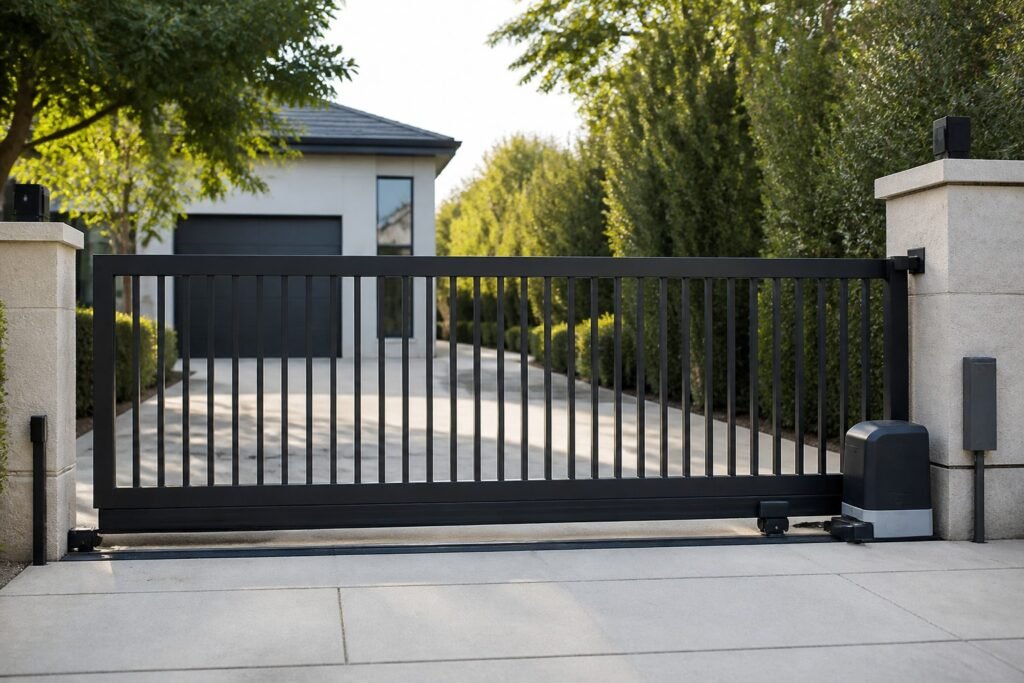
An automatic gate motor is the electric drive unit that opens and closes a driveway gate on command, and when it stops responding, the cause is usually a power issue, a worn component, a sensor problem or a failed remote rather than a dead motor. For Los Angeles County homeowners, a correct diagnosis can save hundreds of dollars, because many fixes involve a single part rather than a full replacement. This guide explains how these motors work, why they fail, how long they last, and what local rules apply.
How an Automatic Gate Motor Works
An automatic gate motor converts electrical power into controlled mechanical movement, guided by a control board that reads signals from remotes, keypads, sensors and limit switches. When you press a remote button, the board energizes the motor, which moves the gate until a limit switch or a set travel distance tells it to stop.
Most residential systems share the same core parts:
- Motor or operator: the drive unit that physically moves the gate through an arm, chain, rack or hydraulic ram.
- Control board: the "brain" that processes commands, timing and safety inputs.
- Limit switches or encoders: components that tell the board where open and closed positions are.
- Safety sensors: photo eyes and edge sensors that stop or reverse the gate when something is in its path.
- Power supply and battery backup: transformers, wiring and, on many systems, a battery that keeps the gate operable during outages.
- Access devices: remotes, keypads, intercoms and smartphone controls.
Understanding this chain helps when troubleshooting. A gate that does nothing at all points toward power or the board, while one that moves partway and reverses usually points toward sensors, obstructions or limit settings.
Types of Automatic Gate Motors
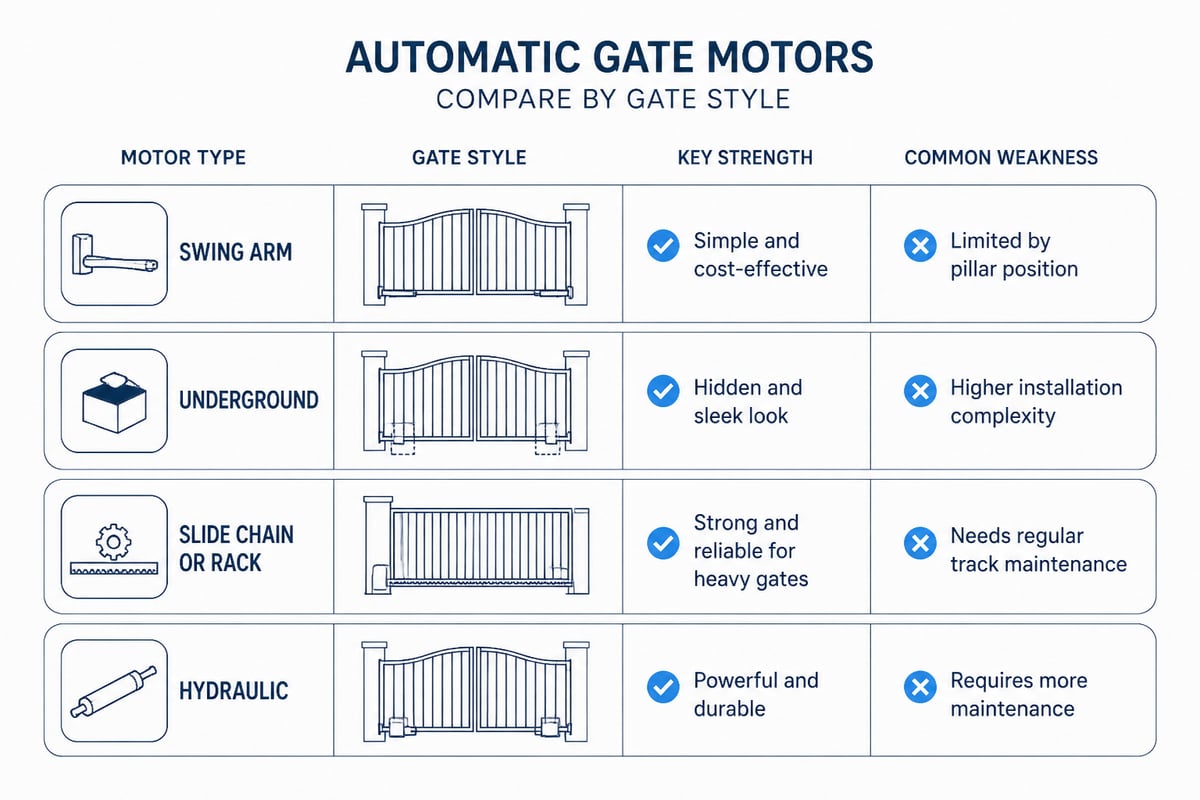
The right motor depends on gate style, weight, driveway layout and how often the gate cycles each day. The four most common residential types are compared below.
| Motor type | Typical gate | Strengths | Common limitations |
|---|---|---|---|
| Swing arm | Single or double swing gates | Affordable, simple, widely serviceable | Needs clearance for the arm to swing |
| Underground | Decorative swing gates | Hidden from view, clean look | Drainage problems and moisture can cause failures |
| Slide (chain or rack) | Sliding gates | Suits sloped or tight driveways | Track debris and roller wear affect performance |
| Hydraulic | Heavy swing gates | Smooth, quiet movement | Fluid leaks and seal wear over time |
If you are weighing an electric motor for a gate that currently opens by hand, the page on when to add an electric motor to your Los Angeles gate covers the decision in more detail. For a broader look at drive units, see this overview of the electric gate motor.
What Is the Lifespan of a Gate Motor?
A well-maintained residential gate motor can last many years, though usage, climate, gate weight and maintenance all affect how long it lasts. No single figure applies to every unit, because a lightly used operator on a lightweight gate will outlast one that cycles dozens of times daily on a heavy iron gate.
Several factors shorten or extend service life:
- Cycle count: every open and close wears gears, bearings and relays.
- Gate weight and balance: a sagging or poorly aligned gate forces the motor to work harder.
- Heat and sun exposure: Los Angeles summers stress plastic housings, batteries and control boards.
- Moisture and debris: underground units and slide-gate tracks are especially sensitive.
- Maintenance habits: annual servicing catches worn parts before they take the motor down with them.
Batteries and control boards often fail before the motor itself. Replacing a board or battery is a modest repair compared with a new operator, which is why a professional diagnosis is worth requesting before you assume the whole unit is finished.
Why an Automatic Gate Motor Stops Working
When an automatic gate motor stops working, the fault usually sits in one of six places: power, the control board, safety sensors, limit settings, the remote or keypad, or the gate's mechanical hardware. Checking them in order from simplest to most complex saves time.
Power and battery problems
Confirm the operator has power and that the breaker has not tripped. On battery-backed systems, a dead or aging battery can keep the gate from responding even when household power is fine. Blown fuses on the control board are another frequent culprit after a power surge.
Sensor misalignment
Photo eyes sit near the base of the gate posts, and a small bump from a car, a gardener's equipment or even a spider web can misalign or block them. A gate that closes partway and then reverses is often telling you a sensor believes something is in the way.
Worn mechanical parts
Hinges, rollers, arms, chains and gear racks all wear. A gate that grinds, shakes, drags or moves unevenly is signaling mechanical stress that will eventually damage the motor if ignored.
Remote and keypad failures
If the gate works from the keypad but not the remote, replace the remote battery first. If neither works, the receiver or board may be at fault. For a practical walk-through of these checks, the guide on how to fix your automatic gate in Los Angeles is a useful reference, and the page on gate motor repairs lists the problems technicians handle most often.
A simple rule: if a fix involves opening the control box, working near high-voltage wiring or removing the motor from its mount, hand it to a licensed technician. DIY troubleshooting should stop at batteries, sensor cleaning and visible obstructions.
Can Thieves Open Electric Gates?
Yes, some electric gates can be opened by determined intruders, but most break-ins exploit weak setups rather than the motor itself. Common vulnerabilities include unprotected manual-release levers, default keypad codes, remotes left in parked cars, and basic radio remotes that are easy to clone.
Practical steps reduce the risk:
- Change default keypad and board codes right after installation.
- Cover or lock the manual release so it cannot be pulled from outside.
- Keep spare remotes out of vehicles parked on the street.
- Choose rolling-code remotes, which change their signal with each use.
- Add a camera or intercom so you can see who is at the gate before opening.
Access control upgrades such as keypads, card readers and smartphone-based controls add another layer. Gates On Site offers access control systems that can be paired with an existing operator, and its smart gate systems page explains remote monitoring options.
What Is the Most Reliable Automatic Gate Opener?
No single brand is the most reliable for every property. Reliability depends far more on matching the operator to the gate's weight, size and daily use, and on proper installation and servicing, than on any badge on the housing.
Use these criteria to judge a motor before buying or replacing one:
- Rated capacity: choose an operator rated well above the gate's actual weight.
- Duty cycle: a motor rated for continuous use handles busy households better than a light-duty model.
- Safety listing: confirm it carries the proper certification, as described in the next section.
- Parts availability: a widely serviced operator is easier and cheaper to repair for years.
- Battery backup: essential in areas that see outages or wildfire-related power shutoffs.
Parts availability deserves extra weight in Los Angeles County. A technician who can find a board or arm the same day keeps your repair time short, which matters more than small differences in specifications.
Safety Standards and UL 325
Automatic gate operators are commonly certified to UL 325, the safety standard that covers slide, swing, pivot, vertical-lift, barrier-arm and bifold gates. The 2024 International Building, Residential and Fire Codes require installed gate operators to be listed to UL 325, so a motor without that listing is a liability on a modern property.
In practice, UL 325 compliance means the gate must have entrapment protection, such as photo eyes or edge sensors, that stops or reverses movement when it detects a person, pet or vehicle. These devices are not optional extras. If a technician tells you a sensor is failing, treat it as a safety repair, not a cosmetic one.
One distinction is worth knowing for homeowners with both a driveway gate and a garage door. The federal rule updating entrapment-protection requirements for residential garage-door operators took effect May 13, 2024, but it applies to garage-door operators, not driveway-gate motors. Your gate falls under UL 325 and local code, while your garage door opener follows its own rules.
Los Angeles County Permits and Rules
Gate projects in Los Angeles County can involve more than one permit, and the requirements differ for the gate itself, the electrical supply and the gate's placement on the lot. Knowing them before work begins avoids stop-work notices and costly rework.
According to Los Angeles County Public Works, a building permit is required for a fence or similar structure over 6 feet high, measured from the lowest adjacent grade. The same source states that an electrical permit is required to supply power to a gate motor, which matters if you are adding a motor to a gate that was previously manual or running new wiring.
Planning review is a separate matter. Los Angeles County Regional Planning reviews a gate for front-yard setback and height compliance regardless of whether a building permit is required. Homeowners in incorporated cities such as Pasadena or Glendale should also confirm whether city rules add requirements beyond the county's. For project-specific cost and scope questions, the pages on motorized gate costs and automatic gate installation are good starting points.
Maintenance That Prevents Gate Motor Failures
Seasonal maintenance is the most reliable way to extend an operator's life and avoid emergency breakdowns. Most of the work takes minutes and can be done without tools.
- Wipe photo eye lenses and check that they face each other squarely.
- Clear tracks, hinges and the area around the gate of leaves, dirt and debris.
- Test the reversing function by placing a soft object in the gate's path, and confirm the gate stops or reverses.
- Check the manual release and make sure it still disengages and re-engages smoothly.
- Inspect the battery and its terminals for corrosion or swelling.
- Listen for new noises such as grinding, squeaking or clicking, and note when they occur.
Annual professional servicing adds lubrication, torque and force adjustments, wiring checks and board diagnostics that homeowners cannot safely perform.
How Do I Build a DIY Automatic Sliding Gate?
A DIY sliding gate project is feasible for experienced builders, but the motor, wiring and safety sensors are where most homeowners should stop and call a licensed technician. The mechanical build, which covers footings, track, rollers and the gate frame, demands accurate leveling and enough clearance beside the driveway for the gate to retract.
The electrical side carries the real risk. Because Los Angeles County requires an electrical permit to power a gate motor, an unpermitted DIY installation can create code and insurance problems later. Sensor placement and force settings also affect whether the finished gate meets UL 325 expectations. If you are replacing a failed motor on an existing gate rather than building from scratch, a professional repair is almost always the faster and safer route, and a good example is the work described in expert automatic gate motor repair in Los Angeles.
When to Repair and When to Replace
Repair often makes sense when the motor is relatively young and the fault is isolated to a board, sensor, battery or arm. Replacement becomes the better value when several components are failing at once, parts are no longer available or the motor cannot handle the gate's weight.
A practical decision framework:
- Repair: one failed part, motor in good mechanical condition, gate hardware sound.
- Replace: repeated repairs within a year, obsolete board or arm, visible gear or housing damage, or a gate that has outgrown the motor's rating.
- Upgrade while you are there: add battery backup, a modern keypad or a smart access system if the gate is already being serviced.
Getting a written diagnosis before committing to either path keeps the decision grounded in the actual fault. For homeowners dealing with a gate that will not move right now, Gates On Site provides same-day electric gate repair across Los Angeles County, with technicians carrying parts and tools in their service vehicles.
FAQ
Can I open my gate manually if the motor fails?
Yes. Most automatic gate operators include a manual release that disconnects the motor so the gate can be moved by hand. Use it during power outages or breakdowns, and re-engage it afterward so the motor can control the gate again.
How often should an automatic gate motor be serviced?
A professional service once a year is a common recommendation for residential gates, with more frequent checks for gates that cycle heavily. Regular servicing catches worn parts, sensor drift and battery decline before they cause a full failure.
Why does my gate open but not close?
This pattern usually points to a blocked or misaligned photo eye, an obstruction in the gate's path or a limit setting that has shifted. Clean and realign the sensors first, and call a technician if the gate still refuses to close.
If your gate has stopped responding, start today by checking the breaker, the remote battery and the photo eye lenses, then note any noises or error lights so you can describe the problem clearly. When those checks do not solve it, Gates On Site, a family-owned business with over 20 years of experience, can send a licensed technician for same-day electric gate repair, with emergency service at no extra charge and a 100% satisfaction guarantee. Call (323) 991-9630 to book a repair visit anywhere in Los Angeles County.